
Onsite, on-site, and on site can all be correct. Onsite is a common one word spelling, on-site is a hyphenated alternative, and on site is a two word phrase. All three can refer to something happening at a particular physical location. The best choice depends on the sentence, the dictionary or style guide you follow, and your organization’s writing conventions.
For example, a company might offer onsite training, advertise on-site support, or ask employees to remain on site until a meeting ends. These expressions communicate a similar location related meaning, but their spelling differs.
If you are unsure whether to write on site or onsite, you do not need to memorize complicated grammar rules. Understanding how each form is used will help you choose the most natural spelling for emails, business documents, job descriptions, reports, and everyday writing.
What Does Onsite or On Site Mean?
Onsite and on site generally mean at a particular physical location. The location could be an office, school, construction project, hospital, warehouse, or customer’s property. The expression helps readers understand where a person, service, or activity is located.
For example, onsite support means assistance provided at the relevant location rather than remotely. Similarly, an inspection conducted on site takes place at the property or facility being inspected.
The hyphenated spelling, on-site, can communicate the same idea. It commonly appears before a noun, as in on-site training or on-site assistance. Different dictionaries, publications, and organizations may prefer different spellings.
The important point is that these forms generally share the same core meaning. The choice is usually a matter of spelling convention and sentence structure rather than a major difference in meaning.
Onsite as One Word
Onsite is a compound word that functions as an adjective or adverb.
As an adjective, it describes a noun by identifying where a service, facility, or activity is available.
Examples include:
- The company provides onsite training.
- Our office has an onsite fitness center.
- The clinic offers onsite testing.
- The position requires onsite attendance.
As an adverb, onsite tells readers where an action takes place or where someone is available.
Examples include:
- A technician will be available onsite tomorrow.
- The consultant worked onsite during the renovation.
- Our support team can assist you onsite.
This one word spelling is particularly common in workplace communication, service descriptions, and job postings.
On-Site as a Hyphenated Form
On-site is another established spelling. It is especially useful as an adjective before a noun.
Examples include:
- The company provides on-site training.
- We offer on-site technical support.
- The property has an on-site management office.
- An on-site inspection is scheduled for Friday.
The hyphen connects the words and makes the expression function as a single modifier. Some dictionaries and style guides prefer this spelling, while others accept or prefer onsite.
If your organization consistently uses on-site in formal documents, there is no need to change it simply because another publication uses onsite.
On Site as Two Words
On site is a common two word expression, particularly when describing someone’s location or where an activity happens.
Examples include:
- The contractor is on site today.
- Please remain on site until the supervisor arrives.
- The engineer completed the inspection on site.
- All visitors must check in before entering the site.
This form is especially natural in sentences that emphasize being physically present at a particular place.
However, the distinction is not absolute. Some publications also use on site before a noun. When writing professionally, follow the spelling convention required by your organization or publication.
On Site vs. Onsite vs. On-Site: What’s the Difference?
All three forms can refer to a person, service, or activity at a particular location. Their main difference is how they are written and how individual style guides treat them.
| Spelling | Typical Use | Example |
|---|---|---|
| Onsite | One word adjective or adverb | We provide onsite support. |
| On-site | Hyphenated modifier, often before a noun | We provide on-site support. |
| On site | Two word location phrase | The technician is on site. |
| Offsite | One word opposite of onsite | We scheduled an offsite meeting. |
| Off-site | Hyphenated alternative | The company arranged off-site training. |
| Off site | Two word location phrase | The equipment is stored off site. |
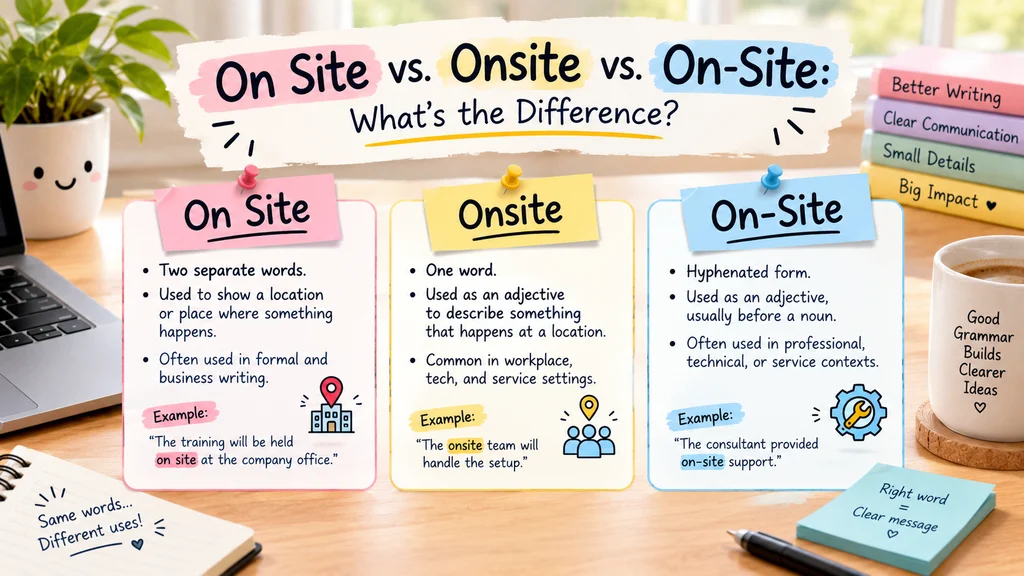
The first three forms can communicate the same basic location related meaning. The offsite forms describe a location away from the relevant premises.
If you are writing an article, report, or professional email, choose a consistent spelling rather than switching between forms without a reason.
When Should You Use Onsite?
Onsite is a convenient choice when describing services, facilities, employees, or activities connected with a specific physical location. It is widely used in modern business communication and everyday professional writing.
1. Workplace Communication
Employers use onsite to describe attendance requirements, facilities, and activities that take place at a workplace.
Examples:
- This position requires onsite work three days a week.
- The company offers onsite professional development.
- An onsite coordinator will answer employee questions.
- Free onsite parking is available for staff.
These examples make it clear where employees need to work or which facilities they can access.
2. Business and Customer Services
Businesses often use onsite to distinguish in person services from remote assistance.
Examples:
- We provide onsite computer repair.
- The vendor offers onsite technical support.
- An onsite consultation is available by appointment.
- Our team can arrange onsite equipment installation.
This wording is helpful when customers need to understand whether a service provider will visit their location.
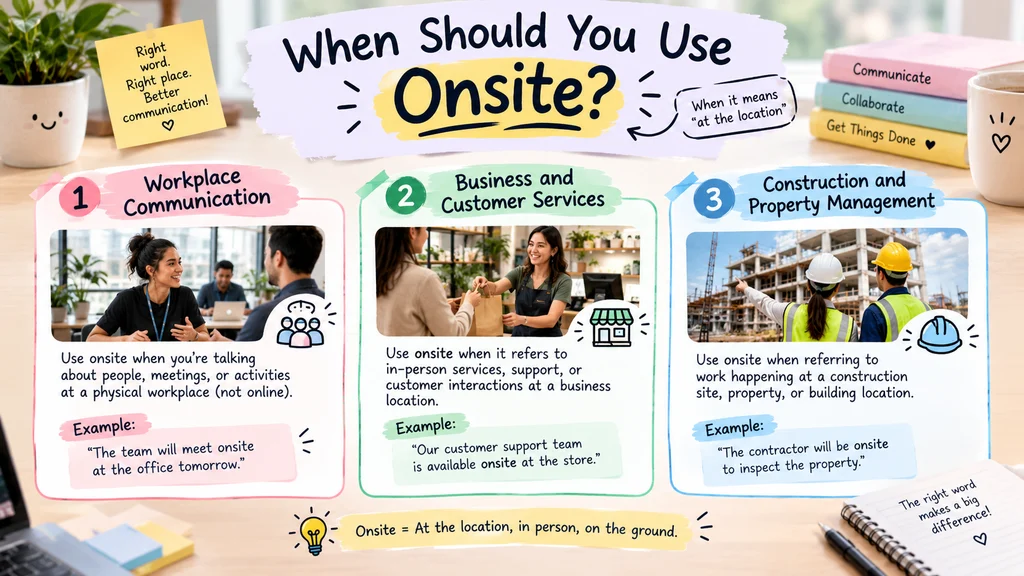
3. Construction and Property Management
Construction projects and property services often involve inspections, supervision, and equipment stored at a specific location.
Examples:
- The project manager will conduct an onsite review.
- An onsite supervisor will monitor the work.
- The contractor completed an onsite assessment.
- Onsite storage is available for approved materials.
The hyphenated form is also suitable in these contexts. For example, on-site inspection is a recognized alternative to onsite inspection.
4. Education and Healthcare
Schools, training centers, and healthcare facilities may use onsite to describe services delivered at their premises.
Examples:
- The school offers onsite tutoring.
- Employees can attend onsite safety training.
- The clinic provides onsite testing.
- An onsite counselor is available during school hours.
Here, the expression describes the location of the service. It does not automatically explain what the service includes or whether it is appropriate for a particular person.
When Should You Use On Site?
On site is particularly natural when a sentence emphasizes someone’s physical presence or the location where an activity occurs.
Consider these examples:
- The contractor is on site until the project is complete.
- Please remain on site during the inspection.
- The engineer reviewed the equipment on site.
- The crew arrived on site early in the morning.
In these sentences, the expression tells readers where a person or activity is located.
You may also see on site used before a noun in certain publications or industry documents. That usage is not automatically an error. Editorial conventions vary, so check your preferred dictionary or style guide if you need a definitive house style.
How to Choose the Right Form
Use these practical guidelines when deciding which spelling to use.
- Choose onsite if you prefer a common one word form, such as onsite training or onsite support.
- Choose on-site if your preferred dictionary, employer, or publication uses the hyphenated spelling.
- Choose on site when describing someone’s location, as in the technician is on site.
- Keep your spelling consistent throughout the same document unless a specific convention requires otherwise.
These are practical preferences, not rigid rules that make every alternative incorrect.
On Site or Onsite in American English
American English uses onsite, on-site, and on site. The preferred spelling can vary by dictionary, publisher, industry, and organization.
For everyday professional writing, onsite is a practical option for familiar expressions such as:
- Onsite training
- Onsite support
- Onsite services
- Onsite staff
- Onsite parking
- Onsite consultation
The hyphenated form is also suitable in phrases such as on-site training and on-site support. Meanwhile, on site works naturally in sentences such as Please remain on site until the work is finished.
If you are writing for a company, university, newspaper, or professional organization, follow its style guide. If no preference exists, select one accepted form and use it consistently.
Examples of Onsite and On Site in Everyday Writing
The easiest way to understand these spellings is to see how they work in real situations.
| Situation | Example Sentence | Why It Works |
|---|---|---|
| Job posting | This is an onsite position. | Describes the work arrangement. |
| Employee email | Please confirm your onsite schedule. | Refers to workplace attendance. |
| Construction report | The inspection was completed on site. | Emphasizes the inspection location. |
| Customer service | We provide on-site technical support. | Describes a service provided at the customer’s location. |
| School announcement | Onsite tutoring begins next week. | Describes tutoring provided at the school. |
| Company event | We are holding an offsite meeting. | Describes a meeting away from the usual workplace. |
Notice that the meaning depends on the sentence, not just the spelling. Each example communicates where an activity takes place or where a service is available.
Common Mistakes to Avoid
Although these spellings are related, writers can still make avoidable mistakes when choosing between them.
1. Assuming Onsite Is the Only Correct Form
Onsite is widely used, but on-site and on site are also established forms.
How to avoid it: Check your preferred dictionary or style guide before correcting someone else’s spelling.
2. Treating On Site as a Spelling Error
The two word expression is valid English usage. It often appears when a sentence emphasizes physical presence.
How to avoid it: Do not automatically replace on site with onsite in every sentence.
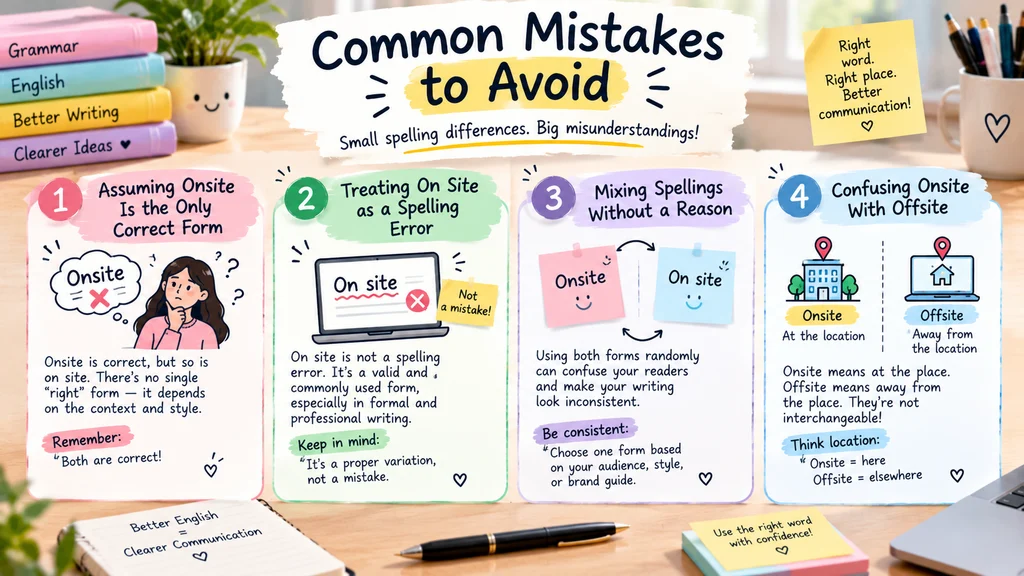
3. Mixing Spellings Without a Reason
A document that uses onsite training, on-site services, and on site support interchangeably may look inconsistent.
How to avoid it: Choose a preferred style for the document and apply it consistently.
4. Confusing Onsite With Offsite
Onsite refers to the relevant location, while offsite refers to somewhere away from that location.
For example, onsite training takes place at the designated premises, whereas offsite training happens elsewhere.
How to avoid it: Check whether the activity takes place at the usual or designated location.
5. Leaving the Location Unclear
Onsite is only useful when readers understand which location you mean.
For example, a technician will be onsite tomorrow may be clear to employees who share an office, but a customer may need to know which branch or property the technician will visit.
How to avoid it: Specify the location when the context does not already make it clear.
Frequently Asked Questions
Is onsite one word or two?
Onsite is written as one word. On site is written as two words, and on-site is hyphenated. All three forms can be correct, depending on the sentence and the spelling convention you follow.
Is on site or onsite correct in American English?
Both are correct in American English. Onsite is a common one word spelling, while on site is frequently used to describe a person’s physical location. On-site is another accepted form.
Should I write onsite training or on-site training?
Both onsite training and on-site training are acceptable. Choose the form recommended by your preferred style guide or use the spelling already established in your organization.
Is on-site one word or two words?
On-site is a hyphenated form consisting of two word elements joined by a hyphen. Onsite is written as one word, while on site has a space and no hyphen.
Is onsite formal enough for a business email?
Yes. Onsite is suitable for professional emails, job descriptions, reports, and business documents. On-site is equally suitable when it matches the style you follow.
What is the opposite of onsite?
Offsite is the usual opposite of onsite. It describes an activity or location away from the relevant workplace or premises. Off-site and off site are also used.
Should onsite be capitalized?
Onsite is normally lowercase in the middle of a sentence. Capitalize it at the beginning of a sentence or according to the capitalization rules used in a title.
Does on site mean the same as at the site?
In many contexts, yes. Both expressions can indicate that someone or something is physically present at a particular location. The most natural wording depends on the sentence.
Conclusion
When choosing on site or onsite, remember that onsite, on-site, and on site are all established forms that can express a similar location related meaning. Onsite is a practical choice for phrases such as onsite training and onsite support. On-site is another common option, while on site works naturally when emphasizing physical presence.
Check your preferred style guide when necessary, and use your chosen spelling consistently. You do not need to treat every alternative as a mistake to write clear, professional English.

Clara Bennett is an English language writer who explains confusing words, grammar differences, and everyday phrases in simple, clear, learner-friendly language.
Pingback: Awhile vs A While: Which One Is Correct?
Pingback: Emigrate vs Immigrate: What Is the Difference?
Pingback: Then vs Than: What's the Difference? (With Examples + Quiz)