
Intact is the correct spelling when you mean whole, complete, undamaged, or unchanged. In tact is generally incorrect when used with this meaning. For example, “The package arrived intact” means the package arrived without being damaged. Although in tact may look natural because of the way the word sounds, standard English uses intact as one word. People often search for in tact or intact because this spelling is easy to divide incorrectly, especially when writing quickly. In this article, you will learn exactly what intact means, how to use it in everyday and professional writing, how it differs from words such as complete and untouched, and which common mistakes to avoid. By the end, you will know when to use intact with confidence.
In Tact or Intact: Which One Is Correct?
Intact is the correct word when you want to say that something remains whole, complete, undamaged, or unchanged.
In tact is generally a spelling mistake when it is used with this meaning. The two forms may sound similar when spoken, but intact is written as one word in standard English.
| Term | Meaning | Correct Use | Example |
|---|---|---|---|
| Intact | Whole, complete, or undamaged | Standard English | The package arrived intact. |
| In tact | Incorrect spelling of intact in this context | Avoid it | The package arrived in tact. |
The easiest rule to remember is simple: when you mean whole or undamaged, use intact as one word.
For example:
The old photograph was still intact.
This means the photograph remained whole and was not damaged.
You can also write:
The original document remained intact.
Here, intact means the document was preserved without being damaged or significantly changed.
What Does Intact Mean?
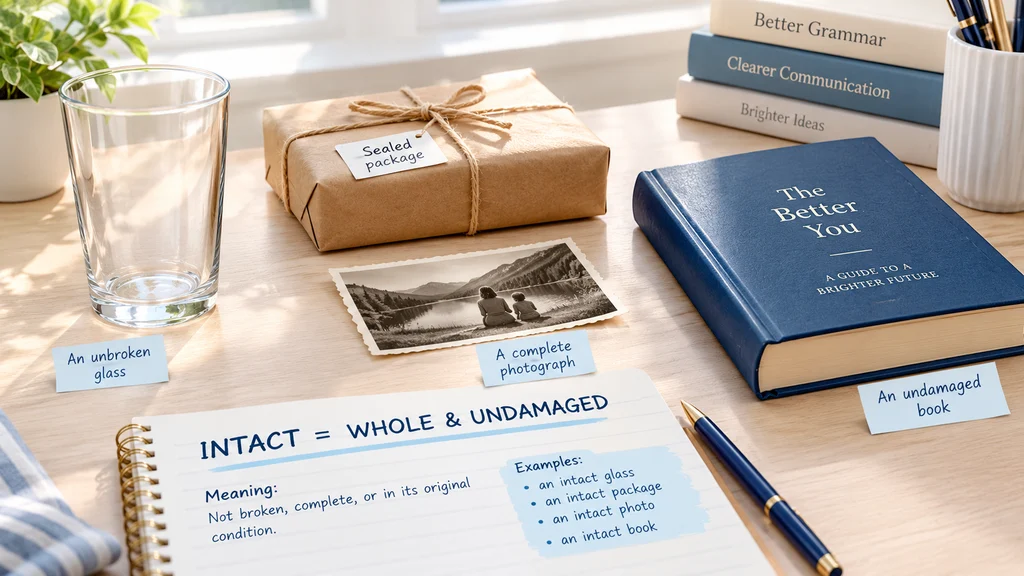
Intact is an adjective that describes something that has remained whole, complete, undamaged, or in its original condition.
The word is commonly used for physical objects. A package, building, photograph, piece of furniture, or electronic device can all remain intact. However, its use is not limited to physical things. You can also describe plans, agreements, traditions, relationships, records, and other abstract things as intact.
For example:
The vase arrived intact.
The vase was not broken.
The original agreement remained intact.
The agreement continued without major changes.
The family tradition has remained intact.
The tradition has continued in essentially the same form.
The exact meaning depends on the context, but the central idea is preservation. Something has not been broken, damaged, separated, or significantly altered.
Intact Means Whole
When something still has all its important parts and has not been broken or separated, intact can mean whole.
The toy was returned intact.
The toy was still complete.
Intact Means Undamaged
When an object survives an accident, move, or delivery without damage, intact can mean undamaged.
The package arrived intact despite the long journey.
The package reached its destination without damage.
Intact Means Unchanged or Preserved
The word can also describe something that remains essentially as it was before.
The original design is still intact.
The design has not been significantly altered.
This broader meaning allows intact to work naturally in many different contexts.
How to Use Intact in a Sentence
A simple way to decide whether intact fits your sentence is to ask whether the subject has remained whole, preserved, or undamaged.
Physical Objects
The antique table remained intact after the move.
The glass bottle arrived intact.
The phone was still intact after the accident.
In these examples, intact describes the physical condition of an object.
Documents and Files
The original receipt was still intact.
The files were recovered intact.
Keep the document intact until the review is finished.
Here, the word suggests that the document or information remained complete and preserved.
Plans and Agreements
The original plan remained intact.
Their agreement stayed intact after the meeting.
In these sentences, intact has a more abstract meaning. The plan or agreement continued without being significantly changed or broken apart.
Traditions and Relationships
The tradition has remained intact for generations.
Their friendship remained intact after the disagreement.
These examples show that intact can describe something that continues to exist in essentially the same condition.
Common Situations Where You Can Use Intact
You may see intact in everyday conversations, school assignments, workplace communication, news writing, academic texts, and professional documents.
Several common phrases are especially useful.
Remain Intact
Remain intact means that something continues in its original or complete condition.
The original structure remains intact.
The evidence remained intact.
The team’s original strategy remained intact.
Keep Something Intact
Keep intact means to preserve something without damaging or significantly changing it.
Please keep the packaging intact.
The museum works carefully to keep historical materials intact.
Try to keep the original document intact.
Arrive Intact
Arrive intact is often used for objects that have been transported from one place to another.
The package arrived intact.
The furniture arrived intact after the move.
The gift arrived intact and ready to be opened.
Survive Intact
Survive intact emphasizes that something remained whole despite a difficult situation.
Several old buildings survived intact.
The original records survived intact.
The structure survived the storm largely intact.
Intact vs. Complete
Intact and complete are related words, but they do not always mean the same thing.
Complete usually means that all necessary parts are present or that something has been finished. Intact focuses on something remaining whole, undamaged, preserved, or unchanged.
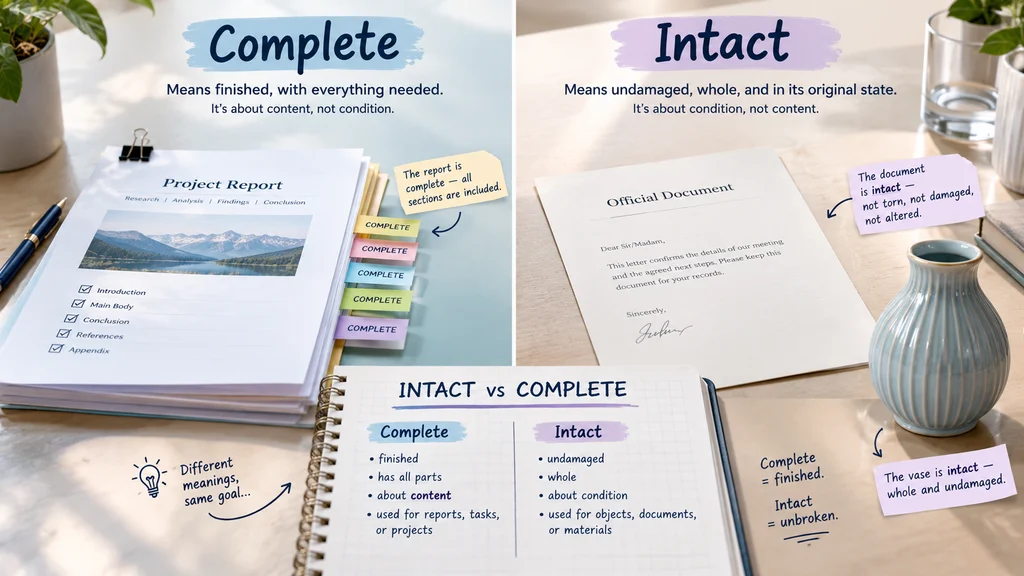
| Word | Main Meaning | Example |
|---|---|---|
| Intact | Whole, undamaged, or preserved | The package arrived intact. |
| Complete | Having all necessary parts or being finished | The report is complete. |
Consider these examples:
The report is complete.
This means the report contains everything it needs or has been finished.
The report is intact.
This suggests that the report has remained whole or undamaged.
A document could be complete but later become damaged. In that situation, it may no longer be intact. This shows why the two words should not always be treated as exact synonyms.
Intact vs. Untouched
Untouched and intact can sometimes describe the same situation, but they emphasize different things.
Untouched usually means something has not been handled, disturbed, used, or changed.
Intact generally emphasizes that something has remained whole, complete, or undamaged.
Compare these sentences:
The room was left untouched.
This suggests that nobody entered and changed or disturbed the room.
The room remained intact.
This suggests that the room continued to exist in a whole or undamaged condition.
The right word depends on what you want to emphasize.
Intact vs. Unchanged
Unchanged focuses specifically on something staying the same.
Intact can include this idea, but it often adds a sense of preservation or wholeness.
Compare:
The original plan remained unchanged.
This means the plan was not altered.
The original plan remained intact.
This suggests that the plan survived and continued to function or exist despite other events.
Both words can be correct, but intact is often the better choice when preservation is part of the meaning.
Examples of Intact in Everyday English
Here are some natural examples showing how intact works in different situations:
- The package arrived intact despite the rough weather.
- The old family photograph is still intact.
- The glass remained intact during the move.
- The original document was returned intact.
- The building’s main structure remained intact.
- The team managed to keep its original plan intact.
- The historical records survived intact.
- The gift arrived intact and ready to be opened.
- The tradition has remained intact for many years.
- Their friendship remained intact after the disagreement.
- The book was still intact after years in storage.
- Please return the item with all original packaging intact.
These examples cover both physical and abstract uses, making it easier to recognize the word in real writing.
Common Mistakes With In Tact and Intact
The spelling becomes easy once you know the rule, but a few mistakes are especially common.
Writing In Tact as Two Words
The biggest mistake is separating intact into two words.
Incorrect:
The package arrived in tact.

Correct:
The package arrived intact.
When you mean whole, complete, preserved, or undamaged, write intact as one word.
Confusing Intact With Tact
Tact is a real English word, but it has a completely different meaning.
Tact means the ability to deal with people and sensitive situations carefully and politely.
For example:
She handled the difficult conversation with tact.
Here, tact refers to sensitivity and good judgment. It does not mean whole or undamaged.
Using Intact to Mean Finished
Intact does not mean finished or completed.
For example:
I completed the assignment.
You would not use intact as a verb to mean completed.
Remember that intact is an adjective.
Assuming Intact Only Describes Physical Objects
Another mistake is thinking that intact can only describe things you can touch.
In fact, the word can describe abstract things too:
The agreement remained intact.
The tradition remained intact.
Their friendship remained intact.
In each case, intact communicates the idea of something being preserved or remaining in place.
A Simple Trick to Remember Intact
If you often confuse in tact or intact, use this simple memory trick:
Intact = still whole.
Whenever you want to say that something stayed whole, complete, preserved, or undamaged, use intact as one word.
You can ask yourself:
Am I describing something that remained whole or preserved?
If the answer is yes, intact is likely the word you need.
For example:
The package arrived intact.
The original design remained intact.
The historical building is still intact.
This simple association can help you remember the spelling whenever you are writing.
Is Intact Formal or Casual?
Intact is a standard English word that works in both everyday and formal writing.
You can use it in a casual sentence:
Luckily, my phone was still intact.
You can also use it in professional or academic writing:
The original structure remained largely intact.
The word is not restricted to formal English. However, it can sound slightly more polished than simpler alternatives such as whole or okay, particularly in professional or descriptive writing.
Frequently Asked Questions
Is in tact or intact correct?
Intact is correct when you mean whole, complete, undamaged, or unchanged. In tact is generally incorrect when used with this meaning.
Is intact one word or two?
Intact is one word. When you mean that something remains whole or undamaged, do not write it as in tact.
What does intact mean in simple English?
Intact means still whole, complete, undamaged, or preserved. For example, if a package arrives intact, it arrives without being damaged.
Can intact describe things other than objects?
Yes. You can use intact for abstract things such as plans, agreements, traditions, relationships, and systems.
For example:
The original agreement remained intact.
This means the agreement continued without significant change.
Is intact the same as complete?
Not exactly. Complete usually means that all necessary parts are present or that something has been finished. Intact emphasizes remaining whole, preserved, or undamaged.
What is the difference between intact and untouched?
Intact means whole, complete, preserved, or undamaged. Untouched usually means something has not been handled, disturbed, used, or changed.
Is tact a different word from intact?
Yes. Tact is a noun referring to sensitivity and skill when dealing with people or difficult situations. Intact is an adjective meaning whole, complete, undamaged, or preserved.
Can I use intact in professional writing?
Yes. Intact is a standard English word and is appropriate for emails, reports, academic writing, workplace communication, and other professional contexts.
Conclusion
When choosing between in tact or intact, remember that intact is the correct spelling when you mean whole, complete, undamaged, or preserved. It is written as one word and can describe both physical objects and abstract things such as plans, agreements, traditions, and relationships.
The easiest memory trick is intact = still whole. If something remains complete or survives without significant damage or change, intact is the word to use. Avoid writing in tact for this meaning, and you will avoid one of the most common spelling mistakes associated with this word.

Evelyn Hart is an English language writer who makes word meanings, grammar differences, and confusing phrases easy to understand through clear, practical explanations.
Pingback: On Site or Onsite: Which Spelling Is Correct?
Pingback: Adverse vs Averse: What Is the Difference? (With Examples + Quiz)
Pingback: To vs Too vs Two: What's the Difference? (With Examples + Quiz)