
Both pleaded and pled are correct past tense and past participle forms of the verb plead. Both mean to make an earnest request or formally respond to a legal charge. Pleaded is a reliable choice for formal writing, while pled is also accepted, particularly in American English.
If you have seen both pleaded guilty and pled guilty, you may wonder whether one spelling is wrong. The answer is no. Both forms are recognized, although writers and publications may prefer one over the other. The choice usually depends on writing style, audience, and context. In this guide, you will learn the difference between pleaded and pled, see practical examples, understand their use in legal and everyday writing, and discover which spelling to choose for school assignments, professional documents, and blog posts.
Pleaded vs. Pled: Comparison Table
| Term | Meaning | Best Use | Example |
|---|---|---|---|
| Pleaded | Past tense and past participle of plead | Formal and general writing | She pleaded for another chance. |
| Pled | Alternative past tense and past participle of plead | General and American English usage | He pled guilty to the charge. |
| Plead | Base form of the verb | Present tense and infinitive constructions | I plead with you to reconsider. |
The main difference between pleaded and pled is usage preference, not meaning. Both forms can be grammatically correct in the same sentence.
What Does Pleaded Mean?
Pleaded is the past tense and past participle of plead. It describes making an earnest request, appealing for help, asking someone to reconsider a decision, or formally responding to a charge in court.
In everyday English, pleaded often communicates that someone feels strongly about a request. For example, if a student pleaded with a teacher for extra time, the student made a serious appeal. The sentence does not necessarily mean the student cried or begged desperately.
In legal contexts, the word has a more specific meaning. When a defendant pleaded guilty, the defendant formally entered a guilty plea in response to a criminal charge. When a defendant pleaded not guilty, the defendant entered a different formal response.
The spelling follows the familiar pattern of adding ed to form the past tense of a verb. This makes pleaded a straightforward option for formal writing, academic assignments, and general informational articles.
Examples:
- She pleaded with her parents to let her attend the school trip.
- The organization pleaded for donations after the storm.
- He pleaded for another opportunity to explain his decision.
- The defendant pleaded not guilty in court.
In each sentence, pleaded describes a past action. It can also function as a past participle when used with a helping verb, as in She has pleaded her case.
The shorter form may look unusual because many English verbs form their past tense by adding ed. However, English includes verbs with alternative past forms, and plead is one of them.
Examples:
- She pled for more time to complete her assignment.
- He pled not guilty during his court appearance.
- The volunteers pled for additional supplies.
- The family pled with the school to reconsider its decision.
These sentences use pled correctly. It is not automatically slang or a spelling mistake simply because it lacks the ed ending.
If you are writing a blog post, school assignment, or professional document, choose the form that fits your preferred style and use it consistently.
When Should You Use Pleaded or Pled?
Both spellings are accepted, but your audience and writing context can help you decide which one to use.
1. Formal and Academic Writing
For school assignments, essays, research papers, and professional documents, pleaded is a dependable choice. It follows the regular past tense pattern and is widely recognized.
Examples:
- The employee pleaded for an extension to complete the project.
- The witness pleaded with the committee to reconsider its decision.
- She pleaded for another opportunity to explain her argument.
You can use pled in formal writing too. However, check your teacher’s instructions or the publication’s style guide if it specifies a preference.

2. American News and Everyday Writing
Both forms appear in American English. You may encounter either spelling in news reports, online articles, workplace communication, and everyday conversations.
Compare these sentences:
- The student pleaded for a second chance.
- The student pled for a second chance.
Both communicate the same idea. If you are writing an informational article, choose one form and maintain that choice throughout the content.
3. Legal Writing
Both pleaded and pled can describe a defendant’s formal response to a criminal charge.
Examples:
- The defendant pleaded guilty to the charge.
- The defendant pled guilty to the charge.
- The defendant pleaded not guilty at the hearing.
- The defendant pled not guilty at the hearing.
The spelling difference does not change the basic meaning. However, actual legal documents may follow specific court rules or jurisdictional conventions. If you are preparing a legal document, follow the applicable requirements rather than relying only on general grammar guidance.
Pleaded vs. Pled Examples in Everyday English
Complete sentences make it easier to understand how both forms work in different situations.
| Situation | Example With Pleaded | Example With Pled |
|---|---|---|
| Asking for help | She pleaded for assistance. | She pled for assistance. |
| Family discussion | He pleaded with his parents. | He pled with his parents. |
| School | The student pleaded for more time. | The student pled for more time. |
| Workplace | She pleaded for a deadline extension. | She pled for a deadline extension. |
| Legal context | He pleaded not guilty. | He pled not guilty. |
| Asking for forgiveness | They pleaded for forgiveness. | They pled for forgiveness. |
The following examples show how context determines the meaning of the verb.
Examples With Pleaded
Example 1: Maya pleaded with her teacher to let her submit the assignment the next morning.
Meaning: Maya made a serious request for extra time.
Example 2: The organization pleaded for donations after the storm damaged several homes.
Meaning: The organization made an earnest appeal for financial support.
Example 3: The defendant pleaded not guilty in court.
Meaning: The defendant formally entered a not guilty plea.
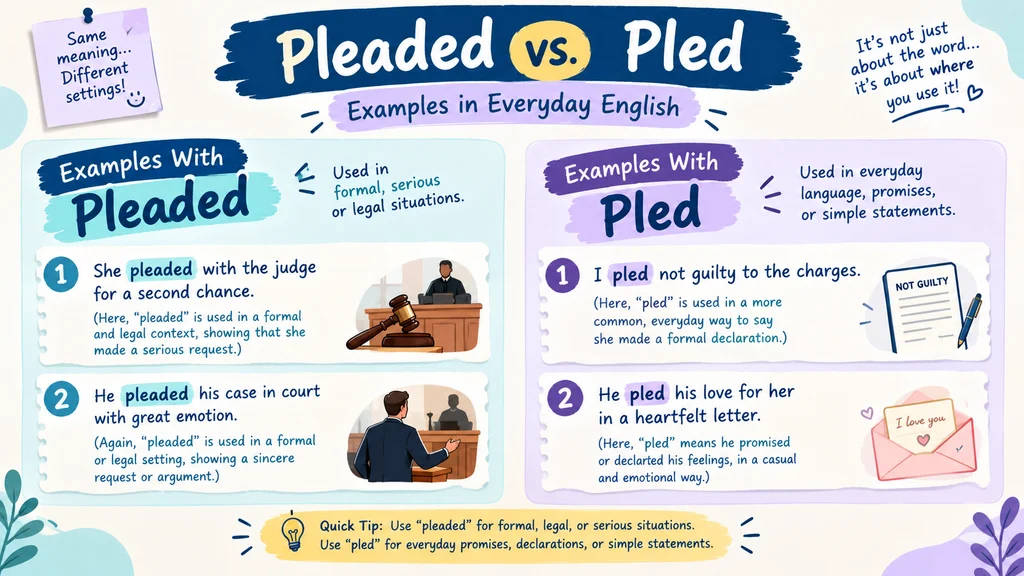
Examples With Pled
Example 1: Jordan pled with his parents to let him join the school trip.
Meaning: Jordan made a strong request for permission.
Example 2: The volunteers pled for additional supplies.
Meaning: The volunteers urgently requested more supplies.
Example 3: The defendant pled guilty during the court proceeding.
Meaning: The defendant formally entered a guilty plea.
In each pair, the spelling changes but the underlying meaning remains the same.
Is Pleaded or Pled More Common in American English?
Both forms are accepted in American English, although preferences can vary across publications and types of writing. Pleaded is a conventional choice for general and formal writing, while pled is also established in American usage, including legal reporting.
It is important to distinguish frequency from correctness. A spelling can be less common in a particular publication without being grammatically wrong.
If you are writing an English grammar article, school essay, business report, or informational website page, pleaded is a practical default. It is familiar to readers and follows the regular past tense pattern.
If you are reporting a court case or quoting a publication that uses pled, you do not need to change it simply because pleaded is another option. Follow the relevant style guide and keep your wording consistent.
There is no universal rule requiring every American writer or publication to prefer the same form.
Plead, Pleaded, Pled, and Pleading: What’s the Difference?
Understanding the different forms of plead can help you avoid tense errors. Although pleaded and pled are alternatives, the other forms have their own grammatical roles.
| Word | Grammatical Form | Example |
|---|---|---|
| Plead | Base form and present tense | I plead for another chance. |
| Pleads | Present tense with he, she, or it | She pleads for help. |
| Pleaded | Past tense and past participle | He pleaded for mercy. |
| Pled | Alternative past tense and past participle | He pled for mercy. |
| Pleading | Present participle and gerund | They are pleading for help. |
Plead
Use plead as the base form of the verb and in the simple present with subjects such as I, you, we, and they.
Example: I plead with you to reconsider.
Pleads
Use pleads with a third person singular subject in the simple present tense.
Example: She pleads for a fair decision.
Pleaded and Pled
Use either form to describe a past action or as a past participle with an appropriate helping verb.
Examples:
- He pleaded for forgiveness yesterday.
- He pled for forgiveness yesterday.
- She has pleaded her case before the committee.
- She has pled her case before the committee.
Pleading
Use pleading for an action in progress or as a noun describing the act of making an appeal.
Examples:
- He is pleading for another opportunity.
- Her pleading did not change the decision.
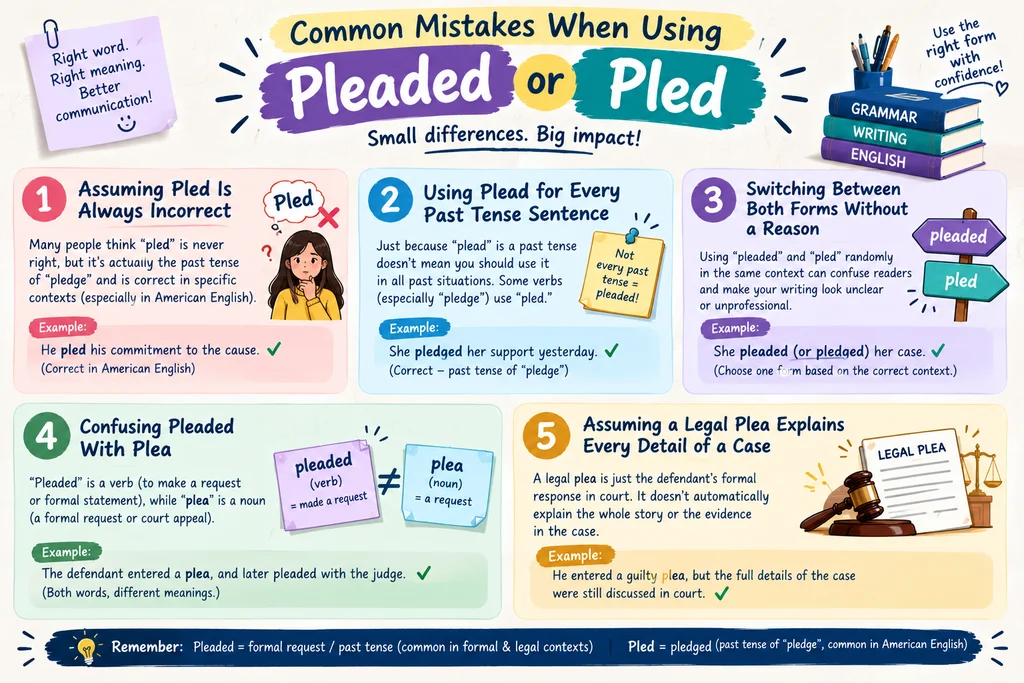
Common Mistakes When Using Pleaded or Pled
Both spellings are correct, but writers can still make mistakes when choosing the tense or constructing a sentence.
1. Assuming Pled Is Always Incorrect
Some writers believe pled is wrong because it does not end in ed. However, it is an established alternative past tense and past participle of plead.
Incorrect assumption: Pled is never correct.
Correct understanding: Both pleaded and pled are accepted forms.
2. Using Plead for Every Past Tense Sentence
The base form plead is not the standard simple past form in modern English.
Incorrect: She plead with her parents yesterday.
Correct: She pleaded with her parents yesterday.
Also correct: She pled with her parents yesterday.
3. Switching Between Both Forms Without a Reason
Using pleaded in one paragraph and pled in another can make an article feel inconsistent.
Tip: Choose one form as your default and follow it throughout the article unless a quotation or specific style requirement calls for the alternative.
4. Confusing Pleaded With Plea
Pleaded and plea are related words, but they serve different grammatical purposes.
Pleaded is a verb form that describes an action. Plea is a noun that describes a request or, in a legal context, a formal response to a charge.
Examples:
- She pleaded for another chance.
- She made a plea for another chance.
- The defendant pleaded guilty.
- The defendant entered a guilty plea.
Understanding this difference helps you choose the correct word for your sentence.
5. Assuming a Legal Plea Explains Every Detail of a Case
The phrases pleaded guilty and pled guilty describe a formal legal response. They do not explain every detail of a case, its evidence, or its outcome.
When writing about legal matters, distinguish the grammatical meaning from the legal implications. For an actual legal issue, consult a qualified legal professional rather than relying on a general grammar guide.
Frequently Asked Questions
1. Is pleaded or pled correct?
Both are correct. Pleaded is the regular past tense and past participle, while pled is an accepted alternative, particularly in North American English.
2. Is pleaded more correct than pled?
No. Neither spelling is universally more correct. Pleaded is a practical choice for formal writing, but pled is also recognized English usage. Follow your publication’s style guide when applicable.
3. Should I write pleaded guilty or pled guilty?
Both phrases are grammatically acceptable. You can use pleaded guilty in formal writing or pled guilty when it fits your preferred style. Both describe entering a guilty plea.
4. Is pled a real word?
Yes. Pled is a recognized English word and an alternative past tense and past participle of plead. It is not automatically a misspelling of pleaded.
5. What is the past tense of plead?
The past tense of plead is either pleaded or pled.
Examples:
- She pleaded for help.
- She pled for help.
Both sentences are correct.
6. What is the past participle of plead?
The past participle can be pleaded or pled. Both forms work with suitable helping verbs.
Examples:
- He has pleaded his case.
- He has pled his case.
7. Do British and American English use pleaded and pled differently?
Usage preferences vary. Pleaded is common in British English and formal writing, while pled is an established alternative in North American English. Both forms are understood, although individual publications may have their own preferences.
8. Which spelling should I use in a school assignment?
Use pleaded unless your teacher or assigned style guide specifies otherwise. It is widely accepted and follows the familiar regular past tense pattern.
Conclusion
When choosing between pleaded or pled, remember that both spellings are correct past tense and past participle forms of plead. They share the same basic meaning, whether you are describing an earnest request or a formal legal response.
For school assignments, professional documents, and general articles, pleaded is a reliable default. However, pled is also acceptable, especially in American English. Choose the form that suits your audience, follow any relevant style guide, and use it consistently throughout your writing.

Grace Holden writes about English vocabulary and common word differences, helping learners understand tricky words with simple, practical explanations.
Pingback: Neice or Niece: Which Spelling Is Correct?
Pingback: Accept vs Except: What's the Difference? (With Examples + Quiz)
Pingback: Complement vs Compliment: What's the Difference? (With Examples + Quiz)