
Both dived and dove are correct past tense forms of the verb dive. In American English, dove is especially common, while dived is also correct and is more common in British English. For example, both “She dove into the pool” and “She dived into the pool” are grammatically correct. The choice can depend on regional English and writing style.
The confusion around dived or dove happens because dive can follow both a regular and an irregular past tense pattern. This guide explains the difference between the two forms, shows how to use them in real sentences, and explains why dived is normally used after has, have, and had. By the end, choosing the right form will be much easier.
Dived vs Dove: What Is the Difference?
The main difference between dived and dove is their usage, not their basic meaning. Both can function as the simple past tense of dive.
Dived is the regular past tense form. It is widely used in English and is particularly common in British English.
Dove is an irregular past tense form that is especially common in American English.
For example:
- She dived into the pool.
- She dove into the pool.
Both sentences mean that she entered the pool by diving. Neither sentence is grammatically wrong.
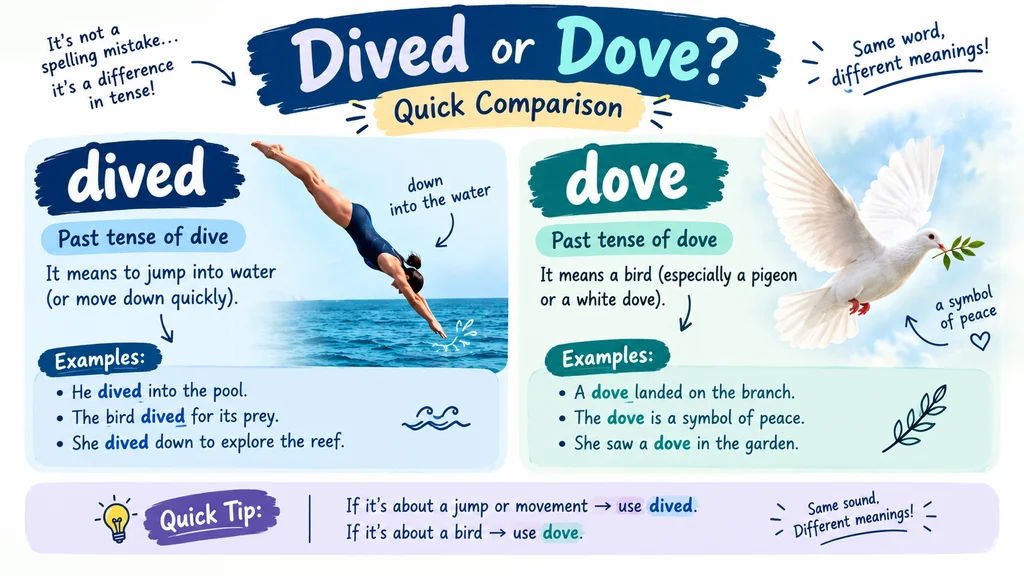
The choice often depends on the variety of English being used. If you are writing for an American audience, dove may sound more natural. If you are following British English conventions, dived is generally preferred.
Dived or Dove: Quick Comparison
| Term | Meaning | Common Usage | Example |
|---|---|---|---|
| Dived | Past tense of dive | Common in British English and accepted generally | She dived into the pool. |
| Dove | Past tense of dive | Especially common in American English | She dove into the pool. |
| Dive | Base form | Present tense or after helping verbs | They dive every summer. |
| Diving | Present participle | Ongoing action | They are diving now. |
The important point is that dived and dove can both be simple past forms of dive. The difference is mainly regional and stylistic.
What Does Dived Mean?
Dived is the regular past tense form of dive. It describes an action that happened in the past.
The verb dive can mean to jump or move quickly into water, move downward suddenly, or move quickly toward something. It can also be used figuratively.
Here are some examples:
- The swimmer dived into the deep end.
- The player dived for the ball.
- She dived into the ocean during her vacation.
- He dived under the table to pick up his phone.
- The students dived into their research.
In each sentence, dived shows that the action happened in the past.
Although American English frequently uses dove, dived is still a completely acceptable form. You do not need to consider it incorrect simply because dove sounds more familiar in some American contexts.
What Does Dove Mean?
Dove is another simple past form of dive. It is especially common in American English.
For example:
- She dove into the pool.
- The swimmer dove into the lake.
- The goalkeeper dove toward the ball.
- He dove underwater to retrieve the object.
- The children dove into the water after lunch.
In these sentences, dove describes an action that already happened.
You may also see dove used in a figurative expression such as dove into. In this context, the person is not necessarily entering water.
For example:
- She dove into her new book.
- He dove into the project as soon as he arrived.
- The students dove into their research.
Here, dove into means that someone started something with energy, focus, or enthusiasm.
When Should You Use Dove?
If you are writing in American English, dove is a very natural choice for the simple past tense of dive.
For example:
- The athlete dove into the pool.
- My brother dove into the lake.
- The baseball player dove for the ball.
- She dove into her homework after dinner.
This form is common in everyday conversation, personal writing, stories, sports writing, and many other types of American English.
If your audience primarily uses American English, choosing dove for the simple past can make your writing sound natural and familiar.
However, that does not mean you must always use dove. Dived is also correct.
When Should You Use Dived?
Dived is particularly common in British English, but it is also accepted in American English.
For example:
- The swimmer dived into the pool.
- The goalkeeper dived toward the ball.
- She dived into the water.
- The bird dived toward the surface.
You can also use dived when you want to follow a traditional regular past tense pattern.
The important thing is not to assume that dived is wrong simply because dove is more common in some varieties of English.
Both forms have a legitimate place in standard English.
Is Dove the Past Tense of Dive?
Yes. Dove is a past tense form of dive.
The base verb is:
Dive
Its simple past can be:
Dived
or
Dove
For example:
Present: The swimmer dives into the pool.
Past: The swimmer dived into the pool.
Past: The swimmer dove into the pool.
The last two sentences describe the same basic action. The difference is the form selected by the writer or speaker.
What Is the Past Participle of Dive?
This is where the distinction becomes especially useful.
For standard edited English, dived is the conventional past participle of dive.
That means you normally use dived after helping verbs such as has, have, and had.
Examples include:
- She has dived into the pool before.
- He has dived from that platform several times.
- They have dived underwater together.
- The swimmer had dived before the coach gave the signal.
In these constructions, has dove or had dove may appear in informal usage, but has dived and had dived are the conventional choices for polished standard writing.
This distinction is worth remembering if you are writing an essay, article, report, or other formal content.
Dived vs Dove in Different Sentences
Looking at the forms side by side makes the difference easier to understand.
| Sentence Type | Preferred Form | Example |
|---|---|---|
| Present tense | Dive | They dive every weekend. |
| Simple past | Dived or dove | They dove into the pool. |
| Present perfect | Dived | They have dived before. |
| Past perfect | Dived | They had dived before sunset. |
| Present continuous | Diving | They are diving now. |
| Infinitive | Dive | They want to dive tomorrow. |
The biggest point to remember is that dove is mainly used as a simple past form, while dived can be used as both a simple past form and the conventional past participle.
Examples of Dived and Dove
Both forms can appear in many different contexts. Here are some practical examples.
Diving Into Water
- The boy dove into the pool.
- The boy dived into the pool.
- The swimmer dove into the ocean.
- The swimmer dived into the ocean.
- She dove into the lake without hesitation.
- She dived into the lake without hesitation.
All of these sentences describe an action that happened in the past.
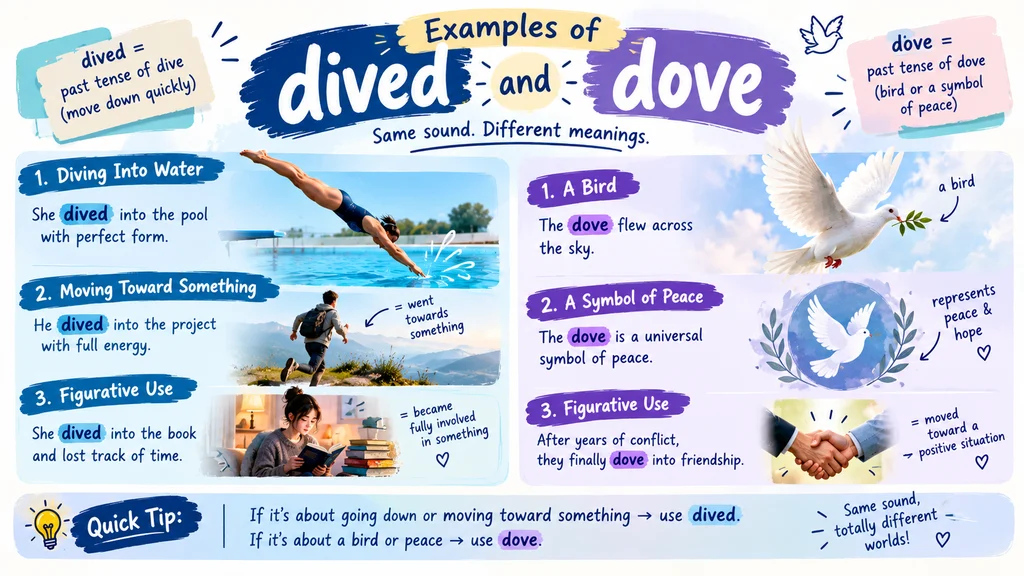
Moving Toward Something
The verb dive does not only refer to entering water. It can also describe moving suddenly toward something.
- The goalkeeper dove for the ball.
- The goalkeeper dived for the ball.
- The player dove to catch the pass.
- The player dived to catch the pass.
Again, both past tense forms are possible.
Figurative Use
Dive into can also mean to begin something with enthusiasm or concentration.
- She dove into her new assignment.
- She dived into her new assignment.
- He dove into the research immediately.
- He dived into the research immediately.
The meaning here is figurative. Nobody is physically diving into the assignment or research.
Dived or Dove in American English
For American English readers, dove is often the more familiar choice when talking about an action that happened in the past.
For example:
Natural American English:
“She dove into the pool.”
“The player dove for the ball.”
“He dove into the project.”
However, dived is not incorrect in American English.
You may encounter sentences such as:
“She dived into the pool.”
“The player dived for the ball.”
These sentences are still grammatically acceptable.
If you are writing specifically for an American audience, dove may feel more natural in simple past sentences. If your writing follows a particular editorial style, however, follow that style consistently.
Dived or Dove in British English
British English generally favors dived as the simple past form.
For example:
- She dived into the pool.
- He dived into the river.
- The goalkeeper dived for the ball.
- They dived underwater.
This does not mean that dove is universally impossible in British English. English usage can vary, and real speakers do not always follow strict regional boundaries.
Still, if you are specifically following British English conventions, dived is generally the safer choice.
Is Dived or Dove More Correct?
Neither form is universally more correct.
The two words are accepted as simple past forms of dive. The main difference is regional preference and grammatical context.
A useful way to remember it is:
American English: dove is especially common.
British English: dived is generally preferred.
Standard past participle: dived is the conventional form after has, have, and had.
So instead of asking which word is always correct, ask what role the word has in the sentence and which English variety you are following.
Common Mistakes With Dived and Dove
Understanding the basic rule prevents several common mistakes.
Using Dove After Did
After did, use the base form dive, not dove or dived.
Incorrect: Did she dove into the pool?
Incorrect: Did she dived into the pool?
Correct: Did she dive into the pool?
The helping verb did already carries the past tense, so the main verb stays in its base form.
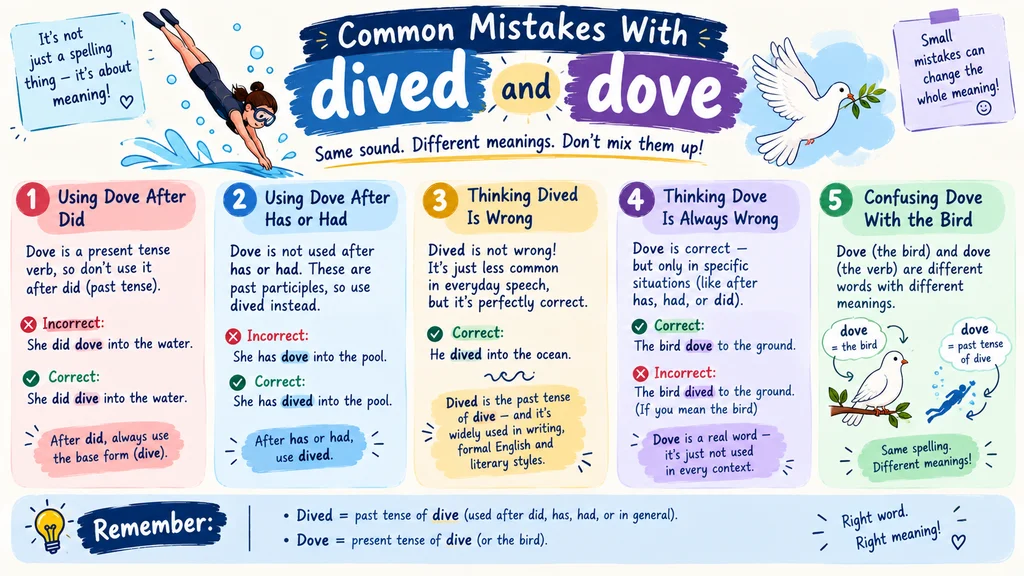
Using Dove After Has or Had
For standard edited writing, use dived after has, have, or had.
Preferred: She has dived into the pool before.
Preferred: He had dived into the water before the storm arrived.
Instead of treating dove as the form for every past construction, remember that it is primarily the simple past form.
Thinking Dived Is Wrong
Some learners assume that dove is the only correct past tense because they hear it frequently in American English.
That is incorrect.
Dived is also correct.
For example:
“She dived into the pool.”
This sentence is grammatically acceptable.
Thinking Dove Is Always Wrong
The opposite mistake is also common. Some people assume that because dived ends in ed, it must be the only correct form.
That is not true either.
“She dove into the pool.”
This sentence is also grammatically correct.
Confusing Dove With the Bird
The word dove has another meaning. It can also refer to a bird.
Compare these sentences:
- The swimmer dove into the pool.
- A white dove flew over the garden.
In the first sentence, dove is a verb. In the second, dove is a noun.
The context makes the difference clear.
Dived or Dove: Easy Rule to Remember
If you want a simple rule, remember these three points:
- Dived and dove can both be simple past forms of dive.
- Dove is especially common in American English.
- Dived is the conventional past participle used with has, have, and had.
For example:
Simple past: She dove into the pool.
Simple past: She dived into the pool.
Present perfect: She has dived into the pool before.
This small pattern will help you avoid most mistakes involving these forms.
FAQs About Dived or Dove
Is dived or dove correct?
Both are correct as simple past forms of dive. Dove is especially common in American English, while dived is generally preferred in British English.
Is dove the past tense of dive?
Yes. Dove is an accepted simple past form of dive. For example, “She dove into the pool” is grammatically correct.
Is dived also the past tense of dive?
Yes. Dived is also a correct simple past form. For example, “She dived into the pool” is correct.
Should I say she dove or she dived?
Either can be correct. If you are writing in American English, she dove is a very natural choice. If you are following British English conventions, she dived is generally preferred.
Is it has dove or has dived?
For standard edited English, has dived is the conventional choice. The same applies to have dived and had dived.
Can I use dove in formal writing?
Yes. Dove is a standard past tense form of dive, especially in American English. However, if you are following a specific regional or editorial style, use the form preferred by that style.
What is the difference between dive, dived, and dove?
Dive is the base form, while dived and dove can both be simple past forms. For example, “They dive every summer,” “They dived yesterday,” and “They dove yesterday.”
Is dove a verb or a noun?
It can be either. As a verb, dove is the past tense of dive. As a noun, a dove is a type of bird. The sentence context tells you which meaning is intended.
Conclusion
When choosing between dived or dove, remember that both are correct simple past forms of dive. Dove is especially common in American English, while dived is generally preferred in British English and remains fully acceptable in other varieties.
The most important grammatical distinction comes with perfect tenses. In standard edited writing, use dived after has, have, and had, as in “She has dived into the pool before.”
So, if you are describing a past action, both “She dove into the pool” and “She dived into the pool” can be correct. Choose the form that fits your audience and writing style, and remember that dived is the conventional past participle.

Lydia Collins is an English language writer who explains confusing words, spelling differences, and everyday grammar in clear, simple language for learners.
Pingback: Pleaded or Pled: Which Spelling Is Correct?