
If you are confused about lifes or lives, the correct standard English word is lives when you mean more than one life. For example, “Many lives were saved” is correct, while “Many lifes were saved” is incorrect. Lives can also be a verb, as in “She lives in Chicago.” The form life’s is different and can show possession or mean life is or life has.
The confusion usually happens because many English nouns form their plural simply by adding s. However, life does not follow that pattern. Its plural changes from f to v, giving us life → lives. Knowing this simple spelling change makes it much easier to choose the correct word.
People often search for lifes or lives because the two forms look like they should work in the same way as other regular plurals. If you know words such as book → books or car → cars, writing lifes may seem logical. Standard English, however, uses lives as the plural of life.
There is another reason this word causes confusion. Lives can have two grammatical meanings. It can be the plural noun of life, or it can be the third person singular form of the verb live. For example, “Their lives changed” uses lives as a noun, while “She lives nearby” uses it as a verb.
Lifes or Lives: Which Is Correct?
Lives is the correct standard form when you are talking about more than one life.
The basic spelling is:
life → lives
For example:
- One life can make a difference.
- Many lives were affected.
- The rescue team saved several lives.
- Their lives changed after they moved.
The spelling lifes is generally incorrect when used as the plural of life.
Compare these sentences:
Correct: The accident affected many lives.
Incorrect: The accident affected many lifes.
If you are writing an article, school assignment, email, social media post, or professional document, use lives rather than lifes.
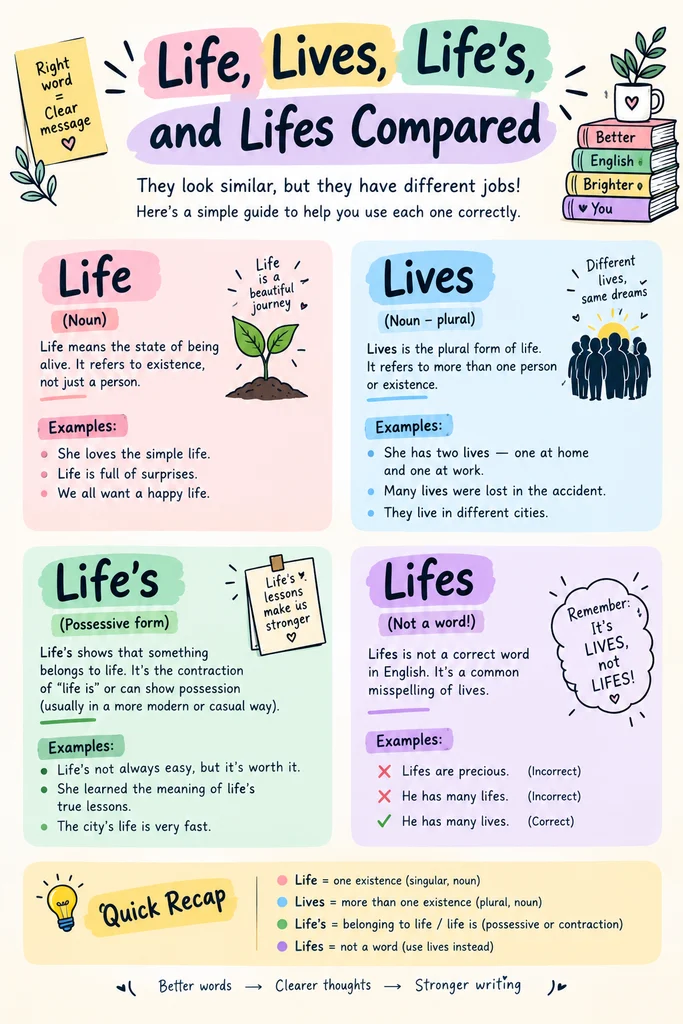
Life, Lives, Life’s, and Lifes Compared
These forms look similar, but they have different meanings and grammatical functions.
| Term | Meaning | Best Use | Example |
|---|---|---|---|
| life | One existence or experience | Singular noun | Life can be unpredictable. |
| lives | More than one life | Plural noun | Many lives were affected. |
| lives | Form of the verb live | Singular subject | She lives in Boston. |
| life’s | Something belonging to life | Possessive form | Life’s challenges can be difficult. |
| life’s | Short for life is or life has | Contraction | Life’s getting better. |
| lifes | Not the standard plural | Generally avoid it | Use lives instead. |
The easiest way to choose the correct form is to first identify what you are trying to say.
If you mean more than one life, use lives.
If you mean that someone resides somewhere, lives can also be correct.
If you mean life is, life has, or something belonging to life, life’s may be the form you need.
What Does Lives Mean?
Lives has two common grammatical uses.
First, it is the plural form of the noun life. In this use, it refers to the existence, experiences, or circumstances of two or more people or living beings.
For example:
Many lives were saved during the rescue.
Here, lives refers to multiple people’s lives.
Another example is:
The decision affected the lives of thousands of families.
In this sentence, lives is a plural noun.
Second, lives is a verb. It is the third person singular form of live.
For example:
She lives in California.
Here, lives does not mean multiple lives. It means that she resides in California.
The surrounding words usually make the intended meaning clear.
Why Is the Plural of Life Lives?
The plural of life is lives, not lifes.
English has several nouns whose spelling changes when they become plural. Some nouns ending in f or fe change to ves.
Examples include:
- life → lives
- wife → wives
- knife → knives
- leaf → leaves
- wolf → wolves
This means you do not simply add s to life.
The correct spelling is:
life + plural ending = lives
The best approach is simply to remember the common spelling pair:
life → lives
However, not every English word ending in f follows the same pattern. English has several exceptions, so it is better to learn the plural form of each word rather than applying one rule to every noun.
When to Use Lives as a Plural Noun
Use lives when you are talking about two or more lives.
It can describe people’s lives, animals’ lives, or the lives of other living beings.
For example:
The firefighters risked their lives to help others.
The storm disrupted the lives of many families.
The new program has improved the lives of local residents.
Their lives changed after graduation.
The accident affected several lives.
In each sentence, lives refers to more than one life.
A simple test can help. If you can replace lives with more than one life, the plural noun is probably being used.
For example:
The event changed many lives.
This means:
The event changed many individual lives.
Therefore, lives is correct.
When to Use Lives as a Verb
Lives can also be the verb form of live.
Use lives when the subject is he, she, it, or another singular noun.
Compare:
- I live in Houston.
- You live in Houston.
- We live in Houston.
- They live in Houston.
- He lives in Houston.
- She lives in Houston.
For example:
My sister lives near the university.
John lives with his parents.
My teacher lives outside the city.
The dog lives with a local family.
With I, you, we, and they, use live rather than lives.
Correct:
They live in Texas.
Incorrect:
They lives in Texas.
This verb rule is separate from the plural noun lives.
Lives vs Life’s
Another common source of confusion is life’s.
The apostrophe makes an important difference.
Lives can mean multiple lives or can be a form of the verb live.
Life’s can show possession or work as a contraction.
For example:
Many lives were affected by the event.
Here, lives is the plural noun.
Now consider:
Life’s challenges can be difficult.
Here, life’s shows possession or association. It refers to challenges associated with life.
There is another use:
Life’s getting busy.
In this sentence, life’s is a contraction of life is.
You can check it by expanding the contraction:
Life’s getting busy.
becomes:
Life is getting busy.
Because the expanded version makes sense, life’s is correct.
How to Pronounce Lives
The pronunciation of lives changes depending on its meaning.
When lives is the plural noun of life, it is pronounced approximately like laivz.
Example:
Many lives were saved.
When lives is the verb form of live, it is pronounced approximately like livz.
Example:
She lives in Seattle.
The spelling stays the same, but the pronunciation changes.
This distinction can be especially useful for English learners because the written form does not show which pronunciation is intended.
Examples of Lives in Sentences
Seeing lives in different contexts can make the difference easier to understand.
Lives as a Plural Noun
Many lives were changed by the decision.
The rescue team worked quickly to save lives.
Their lives became easier after moving closer to family.
The accident affected several lives.
Technology has changed our lives.
The program aims to improve the lives of local families.
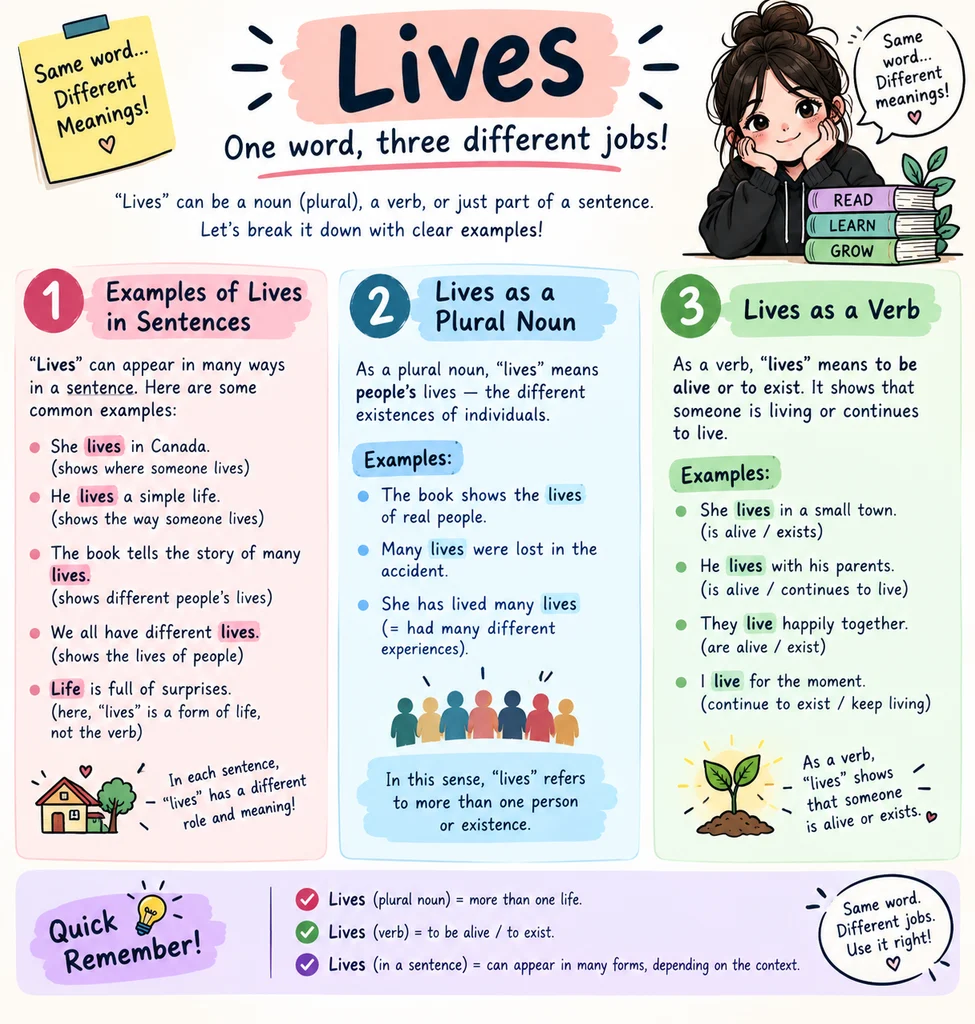
Lives as a Verb
She lives in Los Angeles.
He lives with his brother.
My cousin lives near the airport.
Sarah lives on campus during the school year.
The cat lives indoors.
In these sentences, lives means that someone or something resides in a particular place.
Common Uses of Lives in Everyday English
You will see lives frequently in personal, academic, professional, and everyday writing.
In personal writing:
Our lives have changed since college.
In workplace writing:
The new system has made employees’ lives easier.
In school writing:
Historical events can affect the lives of entire communities.
In everyday conversation:
Our lives are very different now.
In public safety contexts:
The rescue operation saved several lives.
As a verb:
My friend lives nearby.
The meaning becomes clear from the rest of the sentence.
Common Mistakes With Lifes or Lives
Writing Lifes Instead of Lives
The most common mistake is simply adding s to life.
Incorrect:
Many lifes were affected.
Correct:
Many lives were affected.
Remember:
life → lives
Confusing Lives With Life’s
The apostrophe in life’s is important.
Incorrect:
Lifes challenges can be difficult.
Correct:
Life’s challenges can be difficult.
Here, life’s shows possession.
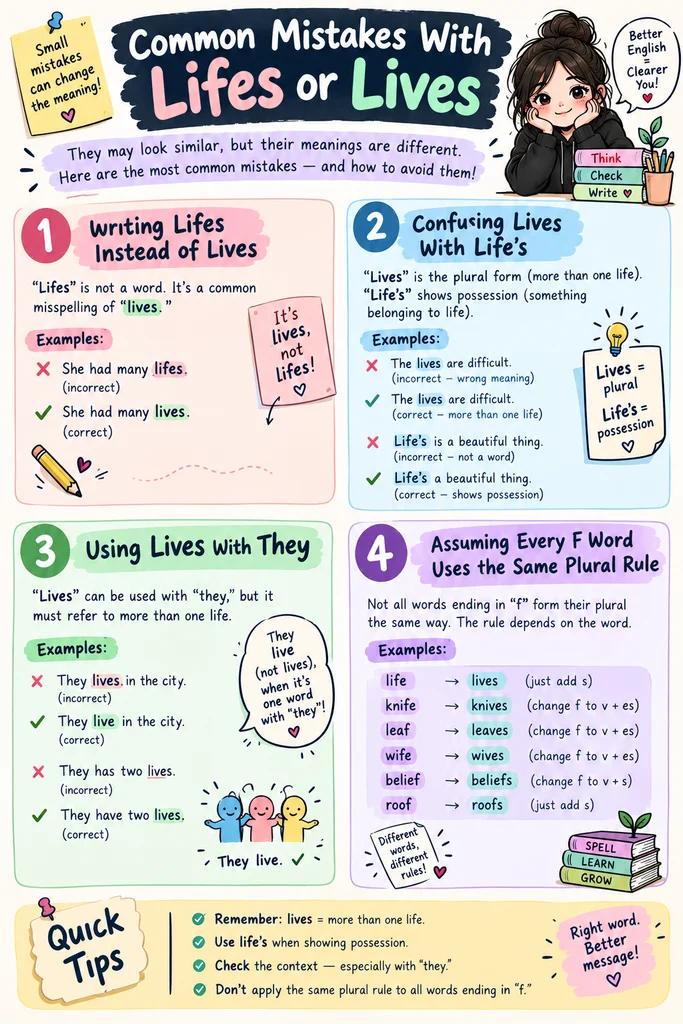
Using Lives With They
When live is used as a verb, remember that lives goes with a singular third person subject.
Correct:
She lives in Chicago.
Correct:
They live in Chicago.
Incorrect:
They lives in Chicago.
Assuming Every F Word Uses the Same Plural Rule
Do not assume that every English noun ending in f changes to ves. English has exceptions to many spelling patterns.
For life, however, the standard plural is clear:
life → lives
A Simple Trick to Remember Lifes or Lives
The easiest rule is:
One life → many lives
If you are talking about where someone resides:
She lives here.
If you are talking about possession or using a contraction:
life’s
For example:
One life can touch many lives.
This sentence gives you the singular and plural forms together.
Another example is:
Life’s journey can be unpredictable.
Here, life’s is different from lives because it contains an apostrophe.
Once you separate the three forms by meaning, the difference becomes much easier to remember.
Frequently Asked Questions
Is lifes a correct word?
Lifes is generally not the standard English plural of life. The correct plural form is lives.
Is it life or lives?
Use life for one life and lives for more than one. For example, “Every life matters” refers to individual life, while “Many lives were saved” refers to multiple lives.
What is the plural of life?
The plural of life is lives. The spelling changes from f to v before the plural ending.
Is lives plural or singular?
Lives is plural when it is the plural noun of life. However, it can also be a singular verb form, as in “She lives in Boston.”
What is the difference between lives and life’s?
Lives can mean more than one life or can be the verb form of live. Life’s can show possession or mean life is or life has.
Can lives be a verb?
Yes. Lives is the third person singular form of the verb live. For example, “He lives in New York.”
Why is life plural lives instead of lifes?
The word life follows a spelling pattern in which the final f changes to v before the plural ending. This gives us life → lives.
How can I remember the correct spelling?
Remember the simple pair life → lives. If you mean more than one life, use lives, not lifes.
Conclusion
When choosing between lifes or lives, use lives when you mean more than one life. For example, “Many lives were affected” is correct, while “Many lifes were affected” is not.
Also remember that lives can be a verb, as in “She lives in Boston.” The form life’s is different because it can show possession or represent life is or life has.
The simplest rule to remember is:
life → lives
Not:
life → lifes

Lydia Collins is an English language writer who explains confusing words, spelling differences, and everyday grammar in clear, simple language for learners.
Pingback: Attornies or Attorneys: Are You Spelling It Wrong?
Pingback: Lay vs Lie: What's the Difference? (With Examples + Quiz)