
Bear in mind is the correct phrase when you mean remember, consider, or keep something in your thoughts. Bare in mind is a common spelling mistake and should not be used when you mean remember. For example, “Please bear in mind that the deadline is Friday” means “Please remember that the deadline is Friday.”
The confusion comes from the fact that bear and bare sound the same in many varieties of English, even though their meanings are different. Bear can mean to carry or hold, while bare describes something uncovered or exposed. In the expression bear in mind, the idea is to mentally hold or remember a piece of information.
If you have ever wondered which spelling to use in an email, school assignment, workplace message, or everyday conversation, this guide will make the difference clear. You will learn what bear in mind means, why bare in mind is incorrect, how to use the phrase naturally, and which similar expressions you can use instead.
What Does Bear in Mind Mean?
Bear in mind means to remember something, consider something, or take something into account. It is commonly used when a person wants someone to keep an important fact or condition in their thoughts while making a decision or taking an action.
For example:
Bear in mind that the store closes at 8 p.m.
This means:
Remember that the store closes at 8 p.m.
The phrase can also suggest that someone should consider a particular factor.
For example:
Bear the total cost in mind before making your purchase.
Here, the speaker is asking the person to consider the total cost before deciding whether to buy something.
The word bear has several meanings in English. As a verb, it can mean to carry, support, tolerate, or endure. In bear in mind, the meaning is figurative. It suggests mentally carrying or holding an idea in your thoughts.
What Does Bare Mean?
Bare is a completely different word. It generally means uncovered, exposed, empty, or without something that would normally cover or fill it.
For example:
- The room had bare walls.
- He walked across the bare floor.
- She was walking around in bare feet.
- The tree had bare branches.
- The shelves were almost bare.
Because bare does not have the meaning of remembering or considering, it does not belong in the expression bear in mind.
Bear in Mind or Bare in Mind: Which Is Correct?
The standard phrase is bear in mind.
Bare in mind is a common spelling error that occurs because bear and bare sound alike. If you are writing something that means remember this or consider this, always choose bear.
| Term | Meaning | Correct? | Example |
|---|---|---|---|
| Bear in mind | Remember or consider something | Yes | Bear in mind that prices may change. |
| Bare in mind | Incorrect spelling of the expression | No | Bare in mind the deadline. |
| Keep in mind | Remember or consider something | Yes | Keep in mind that prices may change. |
A useful memory trick is:
Bear = carry
Bare = uncovered
When you bear something in mind, you can imagine carrying that information mentally.
Why Do People Write Bare in Mind?
The mistake usually comes from pronunciation.
In many English accents, bear and bare are pronounced the same way. Someone may know the expression from conversations but not realize which spelling is correct.
This is similar to other English word pairs that sound alike but have different meanings. Hearing a phrase is not always enough to determine its spelling.
Consider this sentence:
Please bear in mind that the appointment may take longer than expected.
The speaker is asking the listener to remember that information. The word bare would not make sense because it relates to being uncovered or exposed.
How to Use Bear in Mind Correctly
The phrase can appear in several sentence patterns. Choosing the right structure makes your writing sound natural.
Bear in Mind That
This is one of the most common patterns.
Bear in mind that + information
Examples:
- Bear in mind that the deadline is tomorrow.
- Please bear in mind that delivery may take several days.
- Bear in mind that the weather could change.
- You should bear in mind that everyone has different needs.
- Bear in mind that parking is limited.
This structure is especially useful when you want someone to remember a fact, condition, warning, or possibility.
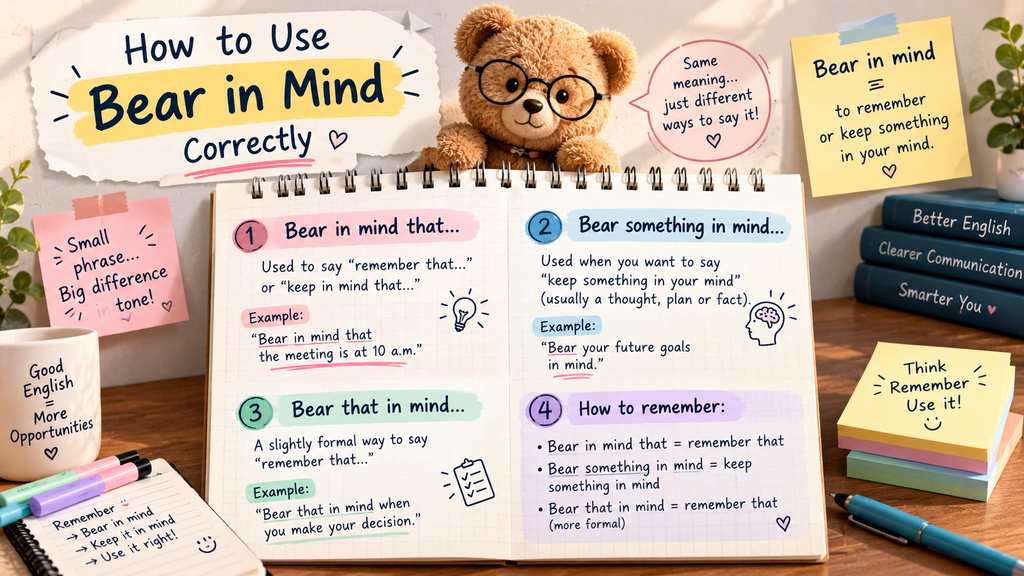
Bear Something in Mind
You can also place the specific thing being considered between bear and in mind.
Examples:
- Bear the deadline in mind when planning your schedule.
- Please bear these instructions in mind.
- Bear the additional costs in mind before making a decision.
- She always bears her long term goals in mind.
- We should bear the customer’s needs in mind.
This construction clearly identifies what the person should remember or consider.
Bear That in Mind
Use bear that in mind when referring to information that has already been mentioned.
For example:
“The restaurant gets very busy on Friday nights.”
“Thanks. I’ll bear that in mind.”
Here, that refers to the information in the first sentence.
Bear in Mind Examples in Everyday English
Understanding the phrase becomes easier when you see it in situations you might actually encounter.
At School or College
- Bear in mind that the assignment is due Friday.
- Students should bear the instructions in mind before starting the test.
- Bear in mind that the exam covers all five chapters.
- Please bear in mind that late work may have different requirements.
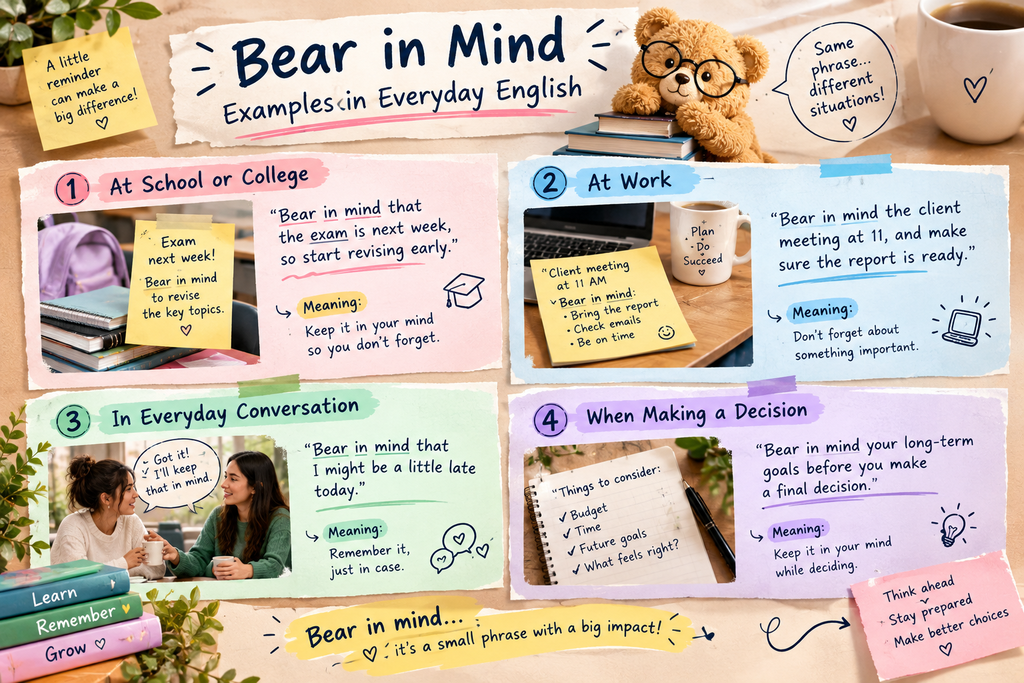
At Work
- Please bear in mind that the meeting starts at 10 a.m.
- Bear in mind that the client requested a shorter presentation.
- We need to bear the project deadline in mind.
- Bear in mind that the schedule may change.
In Everyday Conversation
- Bear in mind that traffic gets heavy around this time.
- Just bear in mind that the restaurant can get crowded.
- Bear in mind that your friend may already have other plans.
- Please bear in mind that this area can be noisy at night.
When Making a Decision
- Bear the total cost in mind before buying the car.
- Bear your schedule in mind when choosing a class.
- Bear in mind that cheaper options may have fewer features.
- Bear in mind how much time the project will require.
Bear in Mind vs Keep in Mind
Bear in mind and keep in mind have very similar meanings. Both can tell someone to remember something or consider a particular fact.
The main difference is usually style rather than meaning. Keep in mind often sounds especially natural in casual everyday conversation, while bear in mind can sound slightly more formal or deliberate.
| Phrase | Meaning | Example |
|---|---|---|
| Bear in mind | Remember or consider | Bear in mind that the store closes early. |
| Keep in mind | Remember or consider | Keep in mind that the store closes early. |
| Remember | Keep information in your memory | Remember that the store closes early. |
| Take into account | Consider a particular factor | Take the closing time into account. |
For most situations, these alternatives can communicate the same basic idea.
Bear in Mind vs Remember
Remember is usually the simplest alternative to bear in mind.
Compare these sentences:
Bear in mind that parking is limited.
Remember that parking is limited.
Both tell the reader to keep the same information in their thoughts.
However, bear in mind can sometimes emphasize the idea of considering information when making a decision rather than simply storing it in memory.
For example:
Bear the total cost in mind before choosing a plan.
This suggests that the cost should influence the decision.
Common Mistakes With Bear in Mind
Knowing the common errors can help you avoid them in your own writing.
Writing Bare in Mind
The most common mistake is using bare instead of bear.
Incorrect: Bare in mind that the store closes early.
Correct: Bear in mind that the store closes early.
Thinking Bear and Bare Have the Same Meaning
Although the words can sound alike, their meanings are different.
Bear can mean carry or tolerate.
Bare can mean uncovered or exposed.
For example:
I can’t bear the noise.
Here, bear means tolerate.
The walls were bare.
Here, bare means uncovered or empty.
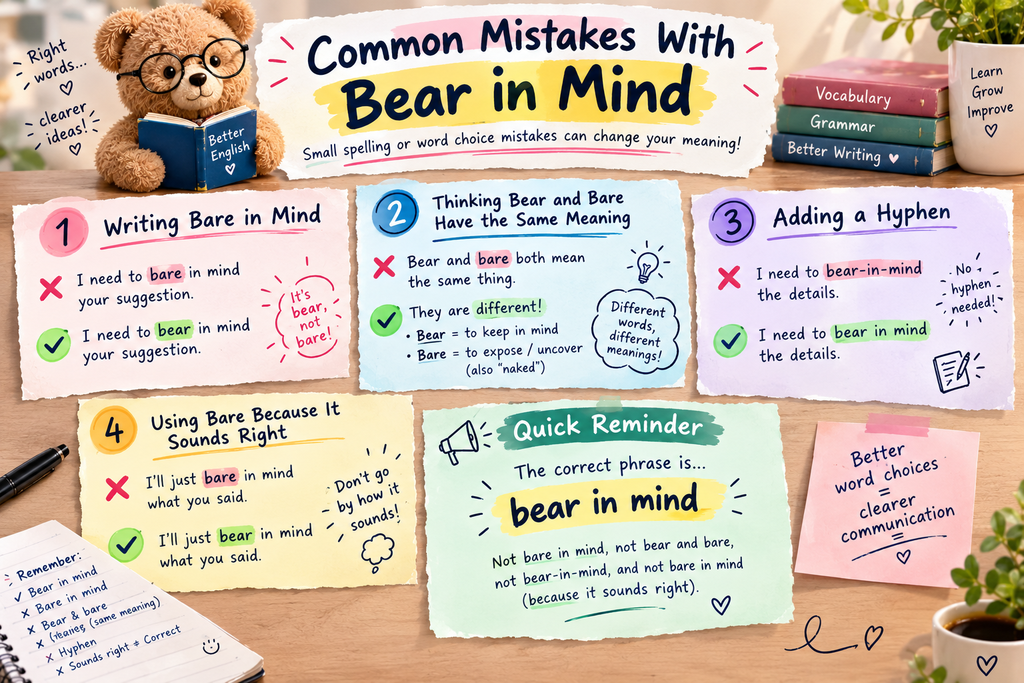
Adding a Hyphen
The expression is normally written as three separate words:
bear in mind
Not:
bear-in-mind
There is no need to hyphenate the phrase in ordinary writing.
Using Bare Because It Sounds Right
Pronunciation cannot always tell you which spelling to choose. If you only hear the phrase, bare in mind may sound perfectly natural. When writing it down, remember that the established expression is bear in mind.
What Is the Past Tense of Bear in Mind?
Because bear is an irregular verb, its forms can sometimes cause confusion.
The common forms include:
- Present: bear in mind
- Past: bore in mind
- Present participle: bearing in mind
- Past participle: borne in mind
For example:
She bore his advice in mind when making the decision.
Another common expression is:
Bearing this information in mind, we changed the schedule.
The meaning remains connected to remembering or considering something.
When Should You Use Bear in Mind?
Bear in mind is useful whenever you want someone to remember or consider information that matters to a situation.
You can use it when:
- Giving an important reminder
- Explaining a condition
- Discussing a plan
- Giving practical advice
- Asking someone to consider a factor
- Writing a professional message
- Explaining instructions
- Discussing a decision
For very casual writing, remember or keep in mind may sometimes sound more natural.
For example:
More neutral: Please bear in mind that appointments are limited.
More conversational: Keep in mind that appointments are limited.
Simple: Remember that appointments are limited.
All three can work depending on the context.
FAQs About Bear in Mind or Bare in Mind
Is it bear in mind or bare in mind?
The correct expression is bear in mind. It means to remember, consider, or keep something in your thoughts. Bare in mind is a common spelling mistake.
What does bear in mind mean?
Bear in mind means remember or consider something. It is often used when someone wants another person to keep an important fact in mind while making a decision or taking an action.
Is bare in mind grammatically correct?
Not when you intend to say remember or consider. The standard expression is bear in mind.
Is bear in mind formal?
Bear in mind is a neutral expression that works in everyday and professional English. In casual conversation, keep in mind or remember may sometimes sound more natural.
Can you say please bear in mind?
Yes. Please bear in mind is a polite way to remind someone about important information.
For example:
Please bear in mind that the schedule may change.
What is another way to say bear in mind?
Depending on the context, you can use remember, keep in mind, consider, take into account, or be aware of.
Why do people confuse bear and bare?
They are pronounced alike in many varieties of English. This can make the spelling difficult to remember, especially for people who have mostly heard the phrase rather than seen it written.
What is an easy trick to remember bear in mind?
Think of bear as carry. When you bear something in mind, you are figuratively carrying or holding that information in your thoughts. Bare means uncovered, so it does not fit this expression.
Conclusion
When choosing between bear in mind or bare in mind, use bear in mind when you mean remember, consider, or take something into account. The word bare has a different meaning and does not belong in this standard expression.
The easiest way to remember the difference is to connect bear with the idea of carrying something. You can think of bear in mind as mentally carrying an important fact with you.
So, when you want to tell someone to remember something, write:
Please bear in mind that the deadline is Friday.

Nora Whitmore is an English vocabulary writer who explores word meanings, common mistakes, and subtle differences between similar words in clear, practical language.