
Awhile and a while are both correct, but they are used differently. Awhile is an adverb that means “for a time,” while a while is a noun phrase that refers to a period of time. The easiest way to choose between them is to check how the word fits into your sentence. For example, you can say, “Stay awhile,” but you would normally write, “Stay for a while.” Although the two expressions sound alike and are closely related in meaning, they are not always interchangeable. Understanding this simple grammar rule will help you avoid common mistakes in emails, essays, professional writing, and everyday conversations. Let’s explore the difference between awhile and a while, learn when to use each expression, and look at practical examples that make the rule easy to remember.
What Is the Difference Between Awhile and A While?
The main difference between awhile and a while is their grammatical function.
Awhile is an adverb. It means “for a time” and usually modifies a verb by explaining how long an action continues.
A while is a noun phrase made up of the article “a” and the noun “while.” It refers to a period of time and can appear in different parts of a sentence.
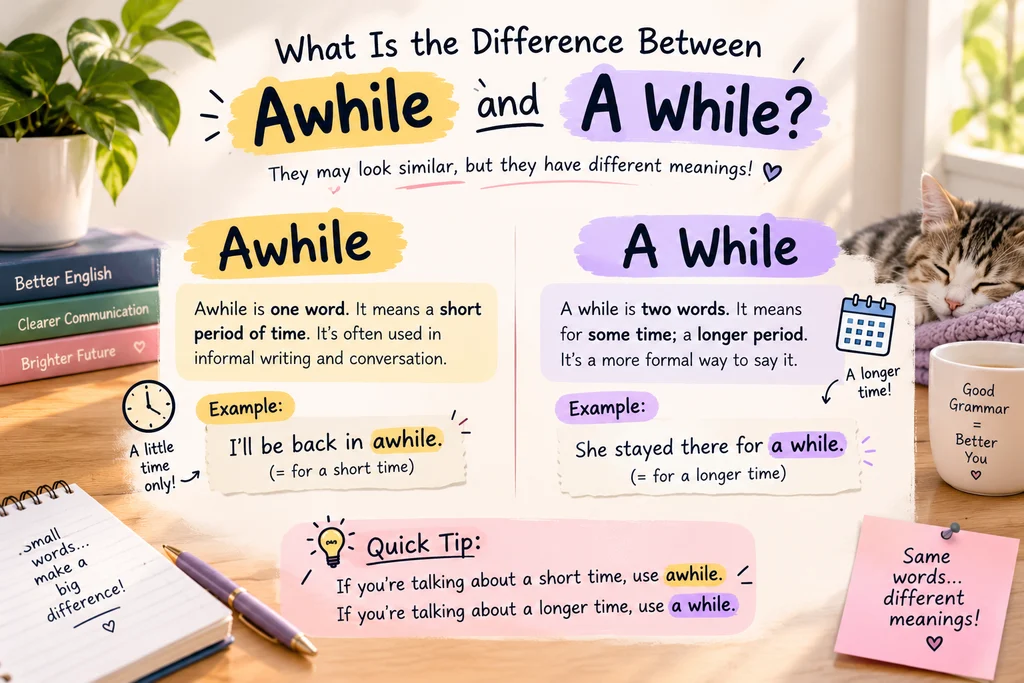
Consider these examples:
| Awhile | A While |
|---|---|
| Please sit awhile. | Please sit for a while. |
| Rest awhile before continuing. | Rest for a while before continuing. |
| We chatted awhile. | We chatted for a while. |
| Not used in the same way after “for” | We waited for a while. |
Both forms can communicate a similar idea, but their grammatical roles determine which one fits a particular sentence.
When to Use Awhile
Use awhile when you need an adverb meaning “for a time.” It often follows a verb and tells the reader how long an action lasts.
A useful way to check your sentence is to replace “awhile” with “for a time.” If the sentence still makes sense, “awhile” may be the right choice.
Examples of Awhile in Sentences
- Stay awhile: You can stay awhile if you are not in a hurry.
- Rest awhile: Let’s rest awhile before we continue walking.
- Wait awhile: Please wait awhile while I finish this task.
- Sit awhile: We sat awhile and talked about our plans.
- Think awhile: Take some time to think awhile before making a decision.
In these examples, “awhile” modifies the verbs “stay,” “rest,” “wait,” “sat,” and “think.” It indicates that the action continues for some time.
Awhile in Everyday Writing
Awhile is common in conversational writing and can also appear in literary or informal prose.
For example:
- The children played awhile in the garden.
- I decided to relax awhile after work.
- She listened awhile before answering.
- Let the tea cool awhile before drinking it.
These sentences use “awhile” as an adverb. However, some writers may prefer “for a while” because it sounds more natural in certain contexts. Both constructions can be appropriate when their grammar is correct.
When to Use A While
Use a while when you are referring to a period of time as a noun phrase. This form is especially common after prepositions such as “for” and “in.”
A simple rule to remember is that for a while is the standard choice when you want to say that something continues over a period of time.
Examples of A While in Sentences
- For a while: We waited for a while before entering the building.
- In a while: I will call you in a while.
- After a while: After a while, everyone began to feel more comfortable.
- A while ago: I saw her a while ago at the library.
- A long while: It took a long while to complete the project.
In each example, “a while” refers to a period of time. The phrase works as part of a larger grammatical construction.
A While in Everyday Writing
Here are more examples showing how to use “a while” correctly:
- It has been a while since we last spoke.
- Please wait for a while before opening the door.
- I have not visited that restaurant in a while.
- We stayed there for a while after the event.
- A while passed before anyone answered.
Notice that “a while” can appear after a preposition, function as part of a time expression, or act as a noun phrase in a sentence.
Awhile vs. A While: Quick Comparison
The following table summarizes the main differences.
| Feature | Awhile | A While |
|---|---|---|
| Part of speech | Adverb | Noun phrase |
| Basic meaning | For a time | A period of time |
| Common use | After a verb | After a preposition or in a noun phrase |
| Example | Stay awhile. | Stay for a while. |
| Example | Rest awhile. | Rest for a while. |
| Memory tip | Means “for a time” | Names a period of time |
The most useful distinction is grammatical rather than semantic. Both expressions relate to time, but “awhile” functions as an adverb, whereas “a while” contains a noun.
Common Mistakes With Awhile and A While
Even experienced writers sometimes confuse these expressions because they sound identical. The following mistakes are easy to avoid once you understand their grammatical roles.
1. Writing “For Awhile”
Incorrect in standard usage: We talked for awhile.
Recommended: We talked for a while.
The word “for” is a preposition, and it is normally followed here by the noun phrase “a while.” Since “awhile” is an adverb, it does not fit this construction in standard edited English.
2. Confusing “Awhile” With “A While”
Less suitable for this construction: It has been awhile since I visited.
Recommended: It has been a while since I visited.
The version with “a while” is the clearer, more widely recommended choice in formal and edited writing. Although you may encounter “it’s been awhile” in informal writing, using “a while” is a safe option when you want to follow standard editorial conventions.
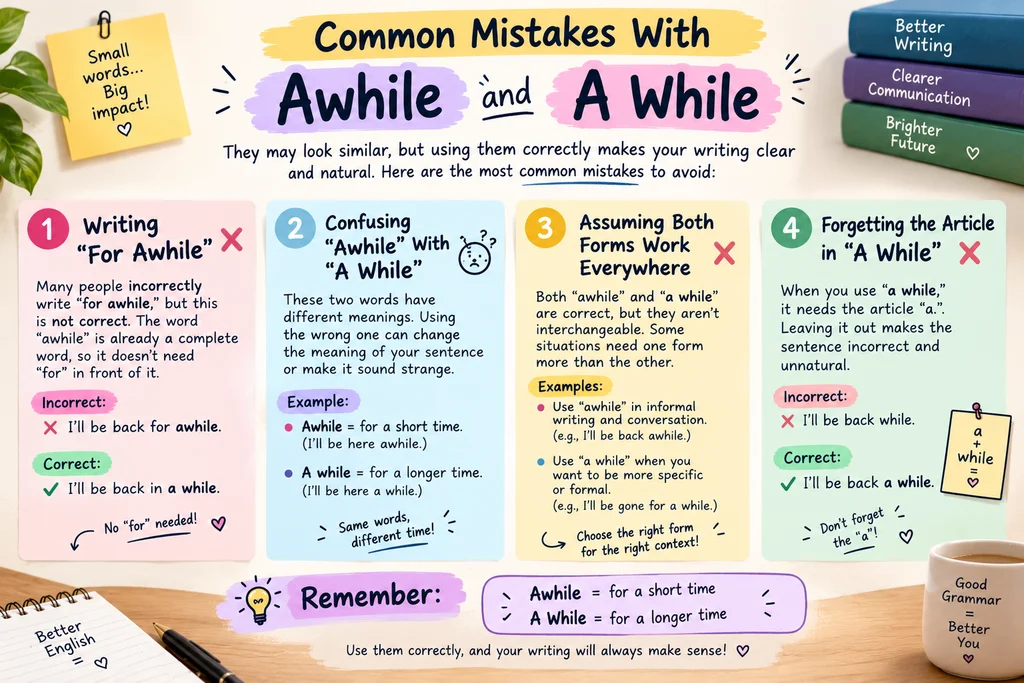
3. Assuming Both Forms Work Everywhere
Incorrect: Please wait for awhile.
Correct: Please wait for a while.
Also correct: Please wait awhile.
The first sentence combines “for” with the adverb “awhile.” The other two sentences use different grammatical constructions correctly.
4. Forgetting the Article in “A While”
Incorrect: I have not seen him in while.
Correct: I have not seen him in a while.
When you use “while” as a noun in this expression, include the article “a.”
Easy Ways to Remember the Difference
If you often mix up awhile and a while, use these simple memory tips.
Tip 1: Try replacing “awhile” with “for a time.”
If the sentence makes sense, the adverb may fit.
Example: “Let’s rest awhile” means “Let’s rest for a time.”
Tip 2: Look for the word “for.”
When you want to use “for” to describe a duration, choose “for a while.”
Example: “We talked for a while.”
Tip 3: Remember that “a while” contains a noun.
You can describe that period with words such as “long” or “short.”
Examples:
- It took a long while.
- We stayed for a short while.
Tip 4: Learn common expressions as complete phrases.
Remember these examples:
- Stay awhile.
- Rest awhile.
- For a while.
- In a while.
- After a while.
- A while ago.
Learning these expressions can make choosing the correct form much easier.
Awhile vs. A While in American English
Both forms are used in American English, and neither is inherently misspelled. The correct choice depends on the sentence structure.
In everyday conversation, speakers may not notice a difference because the expressions are pronounced alike. In writing, however, the distinction matters.
For example:
- Informal: Come sit awhile.
- Also correct: Come sit for a while.
- Standard expression: I will be back in a while.
- Standard expression: It has been a while since we met.
In professional emails, school assignments, and formal articles, choosing the construction that fits the grammar is more important than choosing the expression that sounds more familiar.
Frequently Asked Questions
1. Is awhile one word or two words?
Both forms are correct. “Awhile” is one word and functions as an adverb meaning “for a time.” “A while” is two words and is a noun phrase referring to a period of time.
2. Is it “wait awhile” or “wait a while”?
Both can be correct. “Wait awhile” uses an adverb, while “wait a while” uses a noun phrase. You can also say “wait for a while,” which is a common construction.
3. Is “for awhile” grammatically correct?
In standard edited English, use “for a while” rather than “for awhile.” The preposition “for” is followed by the noun phrase “a while” in this expression.
4. Is it “in awhile” or “in a while”?
Use “in a while” when referring to a period of time. For example, “I will see you in a while.” The expression “in awhile” is not the standard spelling for this construction.
5. Is “it’s been awhile” correct?
You may see “it’s been awhile” in informal writing. However, “it’s been a while” is the clearer and more widely recommended choice in standard edited English.
6. Does awhile mean the same as a while?
They have closely related meanings, but their grammatical functions differ. “Awhile” is an adverb meaning “for a time,” while “a while” is a noun phrase referring to a period of time.
7. Which is correct: “stay awhile” or “stay for a while”?
Both are correct. “Stay awhile” uses the adverb “awhile,” and “stay for a while” uses the noun phrase “a while.” The choice depends on the construction you prefer.
8. How can I remember when to use awhile or a while?
Remember that “awhile” means “for a time” and usually modifies a verb. Use “a while” after expressions such as “for” and “in,” as in “for a while” and “in a while.”
Conclusion
The difference between awhile vs. a while comes down to grammar. “Awhile” is an adverb that means “for a time,” as in “Stay awhile.” “A while” is a noun phrase that refers to a period of time, as in “Stay for a while.”
To choose correctly, check the words around the expression. Use “a while” in common phrases such as “for a while,” “in a while,” and “after a while.” Use “awhile” when it functions naturally as an adverb.
With a little practice, you can use both expressions confidently in everyday conversations, professional emails, and formal writing.

Lydia Collins is an English language writer who explains confusing words, spelling differences, and everyday grammar in clear, simple language for learners.
Pingback: Allusion vs Illusion: What Is the Difference? (With Examples + Quiz)
Pingback: Its vs It's: What's the Difference? (With Examples + Quiz)