
Watch, see, and look all relate to using your eyes, but they have different meanings and uses. See means to notice something with your eyes, often without making a special effort. Look means to direct your eyes toward someone or something, while watch means to pay attention to something, especially when it is moving or changing. For example, you see a bird in a tree, look at a picture, and watch a bird flying across the sky.
Although these three verbs are closely related, choosing the wrong one can make a sentence sound unnatural. The difference often depends on whether you simply notice something, deliberately direct your eyes toward it, or follow its movement over time. Their grammar patterns also matter, especially expressions such as look at, watch TV, and see a movie.
Understanding when to use watch, see, and look will help you describe visual experiences more accurately and communicate naturally in everyday English. Let’s explore their meanings, differences, and practical examples.
What Is the Difference Between See, Look, and Watch?
The easiest way to understand these three verbs is to think about how you use your attention.
- See describes noticing something through your eyesight, often without deliberately trying to.
- Look describes intentionally directing your eyes toward someone or something.
- Watch describes paying attention to someone or something, usually while it moves, changes, or develops.
Consider these three sentences:
- I saw a bird in the garden.
- I looked at the bird through the window.
- I watched the bird build its nest.
All three sentences involve the same bird, but each describes a different experience. First, the bird came into the person’s view. Next, the person deliberately directed their eyes toward it. Finally, they paid attention to what it was doing.
What Does See Mean?
See means to notice, recognize, or become aware of someone or something through your eyes. Unlike look and watch, it does not usually emphasize a deliberate effort to direct your attention.
- I can see the mountains from my bedroom window.
- Did you see that car turn left?
- She saw someone standing outside the store.
- I didn’t see the sign because it was behind the tree.
In each example, the person notices something visually rather than describing the action of deliberately looking at it.
See Can Also Mean Understand
The verb see is also commonly used to mean understand, realize, or recognize an idea.
- I see what you’re trying to explain.
- Now I see why you were upset.
- Do you see what the problem is?
- I didn’t see the connection between those two ideas at first.
Here, see has nothing to do with physical eyesight. It refers to understanding something mentally.
See Can Mean Meet or Visit Someone
We also use see when talking about meeting someone, visiting them, or spending time together.
- I’m going to see my grandparents this weekend.
- She needs to see a doctor about her cough.
- It was wonderful to see you again.
- Are you seeing anyone these days?
The meaning depends on the context. For example, see a doctor means visit or consult a doctor, while see you again refers to meeting someone another time.
What Does Look Mean?
Look means to direct your eyes toward a particular person, object, or place. It usually involves a conscious decision to focus your eyesight in a specific direction.
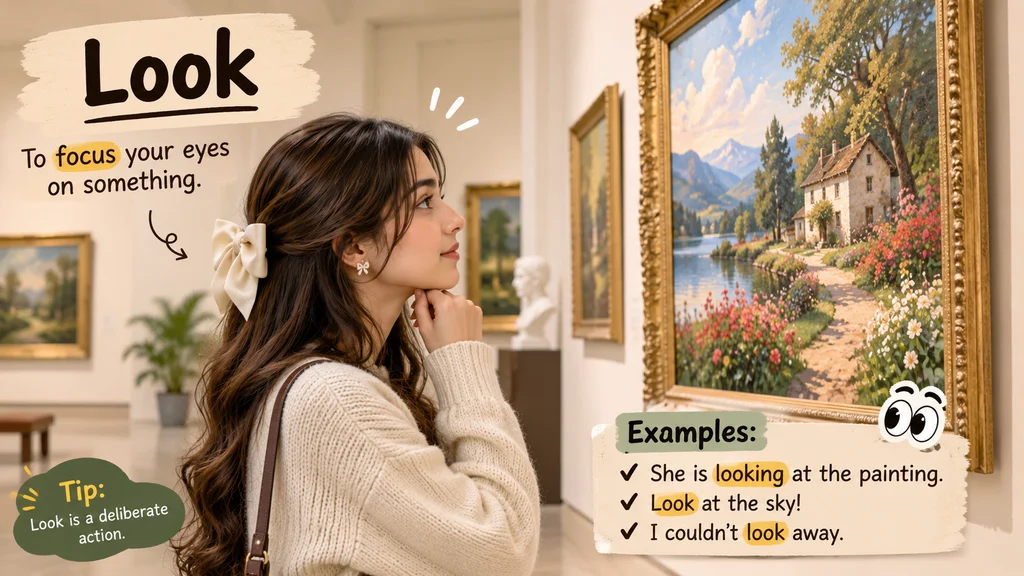
- Look at the beautiful sunset!
- He looked out of the window.
- Everyone looked toward the door when they heard the noise.
- Please look at the instructions before starting.
Notice that when look has a specific object, we commonly use the preposition at.
Look At: Direct Your Eyes Toward Something
Use look at when you want to describe directing your attention toward a particular object or person.
- She looked at the painting for a moment.
- Why are you looking at me?
- He looked at his watch to check the time.
The emphasis is on where someone directs their eyes, not necessarily how long they pay attention.
Look For: Search for Something
Look for means to search for someone or something because you want to find it.
- I’m looking for my phone.
- We spent an hour looking for a parking space.
- Can you help me look for my missing keys?
Compare these two expressions:
- Look at the keys. (Direct your eyes toward them.)
- Look for the keys. (Try to find them.)
Changing the preposition changes the meaning of the expression.
Look Like: Describe Appearance
Look like means to have an appearance similar to someone or something.
- You look like your mother.
- That cloud looks like a rabbit.
- This place looks like a beautiful garden.
We can also use look without like to describe someone’s condition or appearance:
- You look tired today.
- The food looks delicious.
- He looks happy with his new job.
In these sentences, look means seem or appear rather than physically directing your eyes.
Look as a Noun
Look can also function as a noun. It may refer to an appearance, an expression, or the act of looking.
- Take a look at this photograph.
- She gave me a surprised look.
- I like the look of this new design.
- He has a professional look.
What Does Watch Mean?
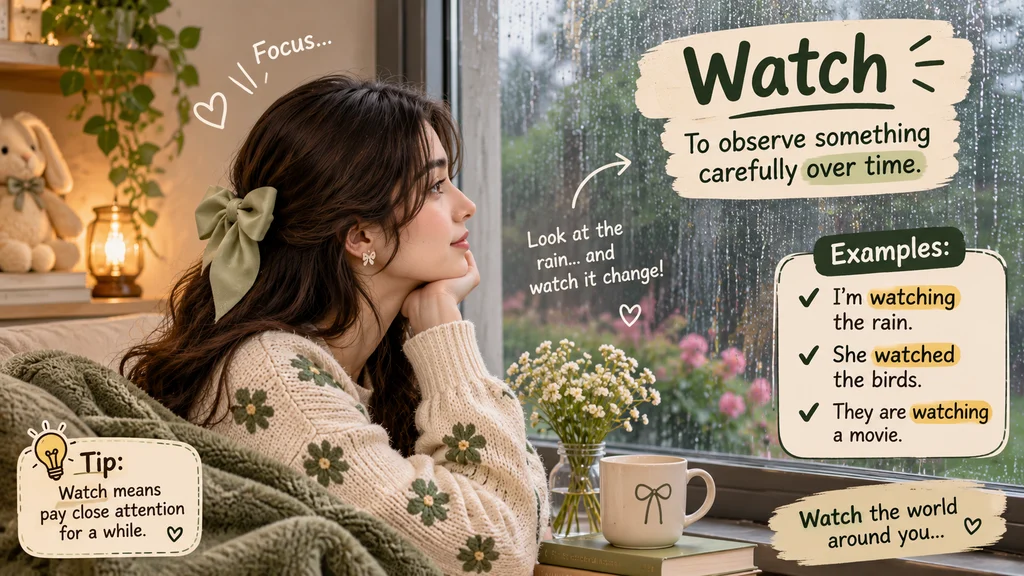
Watch means to observe someone or something carefully, usually for a period of time. It is especially useful when describing an activity, movement, performance, or situation that develops.
- We watched the soccer game together.
- She watched the children playing in the park.
- I like to watch the birds flying across the sky.
- They watched the sun slowly disappear behind the mountains.
Unlike look, which can describe a brief direction of your eyes, watch generally emphasizes continued attention.
Watch Someone or Something in Action
Use watch when you follow an activity or observe how something happens.
- I watched him repair the computer.
- We watched the chef prepare dinner.
- She watched the dog chase a ball.
- The students watched the experiment carefully.
Compare:
- I saw him cross the street.
- I watched him cross the street.
The first sentence simply reports that the speaker noticed the event. The second emphasizes that the speaker paid attention while it happened.
Watch Can Mean Take Care of Someone
Watch can also mean to look after someone or something and make sure they remain safe.
- Can you watch the kids while I prepare dinner?
- She watches her neighbor’s dog when they travel.
- Please watch my bag for a few minutes.
In these examples, watch means supervise or take care of someone or something, not simply observe them.
Watch as a Noun
As a noun, watch has several meanings:
- A small timepiece worn on the wrist: He bought a new watch yesterday.
- The act of observing or keeping guard: The security team kept watch throughout the night.
- A period during which someone is responsible for keeping watch: The sailors took turns standing watch.
See or Look: What’s the Difference?
The main difference between see and look is intention.
See usually describes noticing something with your eyes, while look describes deliberately directing your eyes toward it.
| See | Look |
|---|---|
| I saw a strange bird. | I looked at the strange bird. |
| She saw someone at the door. | She looked toward the door. |
| Did you see the sign? | Did you look at the sign? |
For example, imagine you’re walking down the street and notice a new store. You can say:
I saw a new store on my way home.
If you deliberately turn your head to examine its display, you can say:
I looked at the store’s window.
The difference is not necessarily how long you use your eyes. You can look briefly or for a long time. The important distinction is whether you’re describing noticing something or directing your gaze toward it.
Look or Watch: What’s the Difference?
Both look and watch involve directing your eyes toward something, but they differ in the kind of attention they emphasize.
Use look when you direct your eyes toward someone or something. Use watch when you follow an activity, movement, or change with continued attention.
Compare:
- Look at that dog! It’s so cute.
- Watch that dog! It’s about to jump over the fence.
In the first sentence, the speaker simply directs someone’s attention toward the dog. In the second, the speaker wants the listener to follow what the dog is doing.
More examples:
- She looked at the children in the playground.
- She watched the children play in the playground.
- He looked at the clock.
- He watched the clock as the minutes passed.
- I looked at the waves.
- I watched the waves roll toward the shore.
Remember that watch doesn’t always require visible movement. You can watch a person who is sitting still, for example, if you’re paying attention to what they might do next.
See or Watch: What’s the Difference?
See usually describes noticing something, whereas watch emphasizes paying attention to an activity or event as it unfolds.
For example:
- I saw a plane in the sky.
- I watched the plane take off.
In the first sentence, the speaker noticed the plane. In the second, the speaker followed its movement during takeoff.
Another common example is seeing or watching a movie.
- We saw a movie at the theater last night.
- We watched a movie at home last night.
Both sentences are correct. See a movie is common when talking about going to the cinema or experiencing a film. Watch a movie emphasizes viewing the film itself, especially at home or on a screen. However, the two expressions can overlap.
See, Look, and Watch: Common Mistakes to Avoid
Because these verbs have related meanings, it’s easy to choose the wrong one. Here are some common mistakes and their corrections.
| Incorrect | Correct |
|---|---|
| Look the picture. | Look at the picture. |
| I’m seeing for my keys. | I’m looking for my keys. |
| I watched a bird by accident. | I saw a bird by accident. |
| Watch at the screen. | Look at the screen. |
| I looked the whole match. | I watched the whole match. |
Why do these corrections matter?
- Look commonly needs at before the object when describing where someone directs their eyes.
- Look for is the correct expression when searching for something.
- See is generally the natural choice when describing something you notice unexpectedly.
- Watch is more suitable when describing sustained attention to an event or activity.
Frequently Asked Questions
Is it see a movie or watch a movie?
Both expressions are correct. See a movie often refers to going to the cinema, while watch a movie emphasizes viewing it. The difference is one of emphasis, not a strict grammar rule.
Is look more active than see?
Generally, yes. Look usually involves deliberately directing your eyes toward something, while see often describes noticing something without making a conscious effort to look for it.
Can you use watch without movement?
Yes. Although watch commonly describes observing movement or change, you can also watch someone who is sitting, waiting, or remaining still. The important idea is continued attention.
What is the difference between look at and look for?
Look at means direct your eyes toward something, while look for means search for something.
- Look at the photograph.
- Look for the photograph.
Can see mean understand?
Yes. In everyday English, see often means understand or realize something.
For example: I see what you mean means I understand what you’re saying.
Is watch always longer than look?
Not necessarily. Watch usually suggests sustained attention, while look can be brief or extended. The distinction is more about the type of attention than an exact amount of time.
Final Thoughts
Although see, look, and watch are closely related, they are not interchangeable in every situation. Use see when you notice something, look when you direct your eyes toward it, and watch when you pay attention to an activity or situation as it happens. Once you understand these differences, choosing the right verb becomes much easier. Pay attention to how each word is used in everyday conversations, and you’ll gradually learn to use all three more naturally.

Evelyn Hart is an English language writer who makes word meanings, grammar differences, and confusing phrases easy to understand through clear, practical explanations.