
Do and make are two common English verbs that are often confused, but they are not interchangeable. We generally use do when talking about performing tasks, activities, or responsibilities, while make is used when creating, producing, or bringing something into existence.
For example, we do homework but make a cake. Although this basic rule can help you choose the correct verb, there are many common expressions where you simply need to remember which verb belongs.
Understanding their differences, learning common collocations, and practicing with everyday examples can help you use both verbs more naturally and confidently.
What’s the Difference Between Do and Make?
The main difference between do and make is the type of action they describe.
- Do generally focuses on performing an action, completing a task, or carrying out an activity.
- Make generally focuses on creating, producing, or achieving a result.
For example:
- I need to do my homework before dinner. (Performing a task)
- My mother will make dinner tonight. (Preparing something)
However, this rule does not work for every expression. English has many fixed combinations, called collocations, in which one verb is traditionally used instead of the other. That’s why learning common expressions is just as important as understanding the basic difference.
When to Use Do
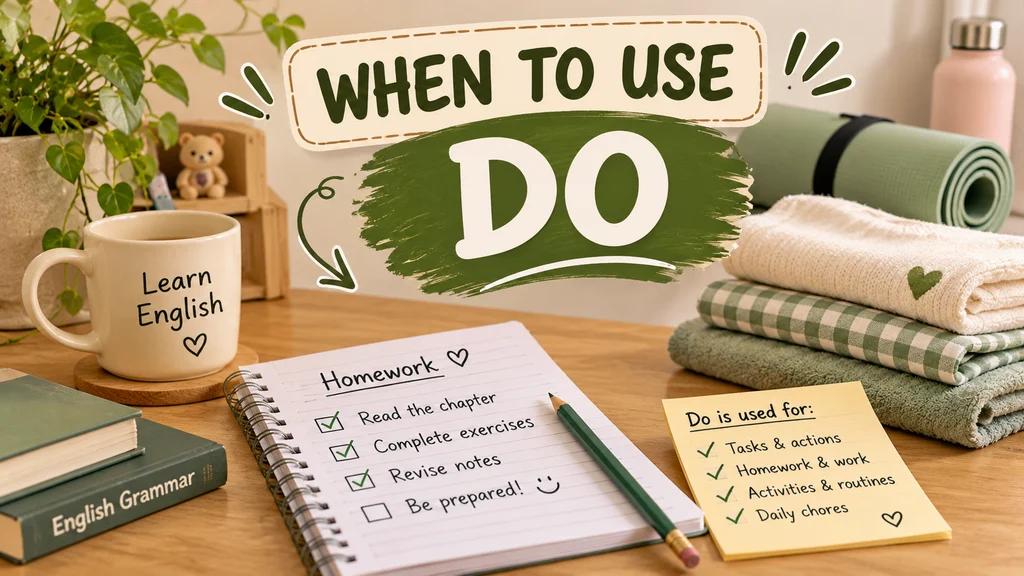
We use do when talking about activities, tasks, duties, and responsibilities. It often refers to actions that are routine, repetitive, or necessary.
Here are the most common situations where we use do.
1. Study and Work
Use do when talking about schoolwork, assignments, professional tasks, and other work-related activities.
- Do homework: I always do my homework after school.
- Do an assignment: She did her English assignment last night.
- Do work: He does a lot of work from home.
- Do a course: I’m doing a photography course this year. (Common in British English; Americans often say take a course.)
- Do research: The students are doing research for their project.
- Do business: Our company does business with several international clients.
2. Housework and Daily Tasks
We commonly use do for household chores and everyday responsibilities.
- Do the dishes: I’ll do the dishes after dinner.
- Do the laundry: She does the laundry every Saturday.
- Do the shopping: We usually do the shopping on weekends.
- Do the ironing: My father does the ironing in our house.
- Do the cleaning: I need to do the cleaning before our guests arrive.
- Do housework: Everyone should help do the housework.
One important exception: We say make the bed, not do the bed.
3. Good or Bad Actions
Use do in expressions that describe how well or badly someone performs an activity or task.
- Do well: Emma did well in her final exams.
- Do badly: He did badly in the competition.
- Do your best: Just do your best, and don’t worry about the result.
- Do something: We should do something to solve this problem.
- Do nothing: He did nothing to help us.
- Do too much: You do too much for other people.
4. Sports, Hobbies, and Exercise
We often use do with certain sports, physical activities, and hobbies, particularly those that don’t involve playing a ball game.
- Do exercise: You should do some exercise every day.
- Do yoga: My sister does yoga every morning.
- Do karate: Jack has been doing karate for three years.
- Do gymnastics: She does gymnastics at her local sports center.
- Do crossword puzzles: My grandfather enjoys doing crossword puzzles.
Remember that we generally use play with sports and games such as football, tennis, and basketball.
5. Do Something, Anything, or Nothing
The verb do is also used with words such as something, anything, everything, and nothing.
Examples:
- Are you doing anything interesting this weekend?
- I don’t have anything to do right now.
- Let’s do something fun together.
- She does everything around the house.
- There’s nothing we can do about it.
When to Use Make
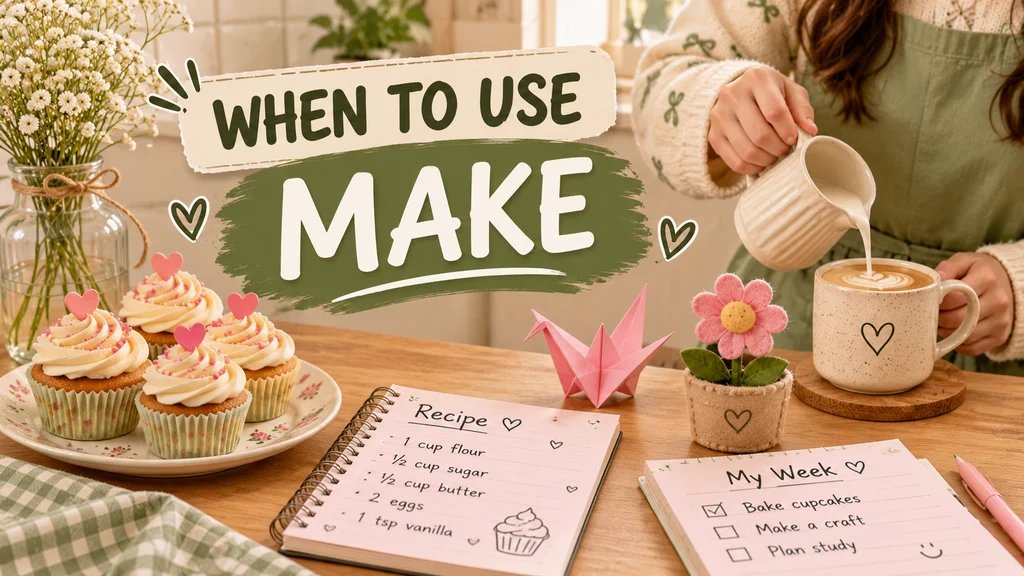
We generally use make when talking about creating, preparing, producing, or causing something. It often emphasizes the result of an action rather than the activity itself.
Here are the most common situations where we use make.
1. Food and Drinks
Use make when preparing meals, drinks, snacks, and other food items.
- Make breakfast: I’ll make breakfast for everyone.
- Make lunch: She makes lunch before leaving for work.
- Make dinner: We’re making dinner for our guests tonight.
- Make a cake: My sister made a chocolate cake for my birthday.
- Make coffee: Could you make me a cup of coffee?
- Make a sandwich: He made a sandwich before going to work.
2. Plans and Decisions
We use make when talking about decisions, arrangements, choices, and plans.
- Make a decision: It’s difficult to make the right decision sometimes.
- Make plans: We’re making plans for our summer vacation.
- Make a choice: You need to make a choice before Friday.
- Make an appointment: I made an appointment with my dentist.
- Make arrangements: They are making arrangements for the wedding.
- Make a list: I made a shopping list before going to the supermarket.
3. Creating and Producing Things
Use make when something is created, manufactured, or produced.
- Make a dress: My grandmother made this dress herself.
- Make furniture: The company makes wooden furniture.
- Make a film: They are making a new documentary.
- Be made of: This table is made of solid wood.
- Be made from: Paper is made from wood.
- Be made in: This watch was made in Switzerland.
4. Causing Something to Happen
We use make when one person, action, or situation causes a particular feeling, reaction, or result.
- The funny movie made everyone laugh.
- Good news makes me happy.
- The loud noise made the baby cry.
- Regular practice makes you a better player.
- Eating too much can make you feel uncomfortable.
Notice the grammatical structure:
Make + person or thing + base verb/adjective
Examples:
- My teacher made me rewrite the essay.
- The story made her sad.
- His joke made everyone smile.
5. Sounds, Communication, and Relationships
We use make in many expressions related to speaking, communicating, and interacting with others.
- Make a noise: Please don’t make so much noise.
- Make a phone call: I need to make an important phone call.
- Make a suggestion: She made a useful suggestion.
- Make a speech: The principal made a speech at the ceremony.
- Make a joke: He made a funny joke during dinner.
- Make friends: It’s easier to make friends when you join a club.
- Make a promise: He made a promise to help his brother.
6. Money and Business
Use make when talking about earning money, generating profits, and completing financial transactions.
- Make money: She makes money by selling handmade products.
- Make a profit: The business made a profit last year.
- Make a living: He makes a living as a photographer.
- Make a payment: I need to make a payment today.
- Make $20 an hour: She makes $20 an hour at her part-time job.
- Make a loss: The company made a loss during its first year. (Common in British English; Americans often say suffer a loss.)
Common Collocations with Do and Make
Some expressions don’t follow the basic rules of do and make. These combinations are called collocations, meaning words that naturally go together in English.
The best way to learn them is to remember the complete expressions rather than trying to translate each word individually.
Common Collocations with Do
| Collocation | Example |
|---|---|
| Do someone a favor | Can you do me a favor? |
| Do damage | The storm did a lot of damage. |
| Do your duty | Everyone must do their duty. |
| Do a crossword | My grandmother does a crossword every morning. |
| Do your best | Always do your best. |
| Do business | They do business internationally. |
| Do a good job | You did a good job on this project. |
| Do a puzzle | The children are doing a puzzle. |
| Do the right thing | Sometimes it’s difficult to do the right thing. |
Common Collocations with Make
| Collocation | Example |
|---|---|
| Make a mistake | I made a mistake in my answer. |
| Make progress | She is making good progress in English. |
| Make an effort | You need to make an effort to improve. |
| Make sure | Make sure you lock the door. |
| Make an offer | The company made an offer for the property. |
| Make the bed | I make my bed every morning. |
| Make a complaint | The customer made a complaint. |
| Make an excuse | He made an excuse for being late. |
| Make a prediction | The scientist made a prediction about the future. |
| Make friends | She made several friends at her new school. |
Common Mistakes with Do and Make
Even advanced English learners sometimes confuse these verbs because their meanings can be similar. Here are some common mistakes and their correct forms.
| Incorrect | Correct |
|---|---|
| Make homework | Do homework |
| Do a mistake | Make a mistake |
| Do a decision | Make a decision |
| Make exercise | Do exercise |
| Do a phone call | Make a phone call |
| Do the bed | Make the bed |
| Make your best | Do your best |
| Do a promise | Make a promise |
| Make business | Do business |
| Do progress | Make progress |
Tip: Don’t rely only on translating expressions from your native language. Learn the correct English collocation as a complete phrase.
Do vs. Make Examples in Everyday English
Here are some additional examples showing how to use both verbs naturally in everyday conversations.
- I need to do my homework before I can watch television.
- My mother usually makes breakfast for the family.
- Could you do me a favor and close the window?
- We need to make a decision about our holiday plans.
- She always does her best when working on a project.
- They made a lot of progress during the first week.
- I forgot to make my bed this morning.
- He does the shopping every Friday.
- The children made a lot of noise during the party.
- You should do some exercise to stay active.
Frequently Asked Questions
1. What is the main difference between do and make?
Do generally refers to performing an action, task, or activity, whereas make usually refers to creating, producing, or achieving something. For example, we say do homework but make dinner.
2. Do we say do homework or make homework?
The correct expression is do homework. We use do because homework is a task that students complete, not something they create.
3. Is it make a mistake or do a mistake?
The correct expression is make a mistake. For example: “I made a mistake in my English test.”
4. Is it make money or do money?
We say make money when talking about earning or generating income. For example: “She makes money by working online.”
Conclusion
Understanding the difference between do and make becomes easier when you learn their common uses and expressions. Remember that do generally focuses on performing tasks and activities, while make focuses on creating something or producing a result. However, many expressions are fixed collocations, so it’s important to learn them through examples and regular practice. Pay attention to how English speakers use these verbs, and try making your own sentences with common expressions. The more you practice, the more naturally you’ll choose between do and make.

Grace Holden writes about English vocabulary and common word differences, helping learners understand tricky words with simple, practical explanations.
Pingback: Say or Tell: What’s the Real Difference?